10 Health “Facts” Everyone Believes That Aren't True
Eight glasses of water, 10,000 steps and the dreaded knuckle crack. Some of the most repeated health rules started as marketing, wartime cover stories or one stubborn misunderstanding. Here's what the research says.

Written by: Gareth Shelwell
Read time: 6 minutes
Where do health myths come from?
Most health myths aren't invented out of thin air. They usually start with a grain of truth, a misread study or a catchy number that's easy to repeat.
Then they get passed around at barbecues, in gym change rooms and in the family group chat until everyone “just knows” them. Some are even believed by doctors. (1)
Here are ten of the most stubborn, and how they hold up.
What to know
The 10,000-step target started as the name of a 1960s Japanese pedometer, not a scientific finding. (3)
One doctor cracked the knuckles of only one hand for 60 years. Neither hand developed arthritis. (5)
Australian fluid guidelines count all drinks, not just plain water, and food adds more on top. (2)
A few myths are half true, so the details matter more than the slogan.
1. “You need to drink 8 glasses of water a day”
Verdict: half true
This one likely traces back to a 1945 US recommendation of about 8 glasses' worth of fluid a day. The part that got lost was that most of it already comes from food and other drinks. (1)
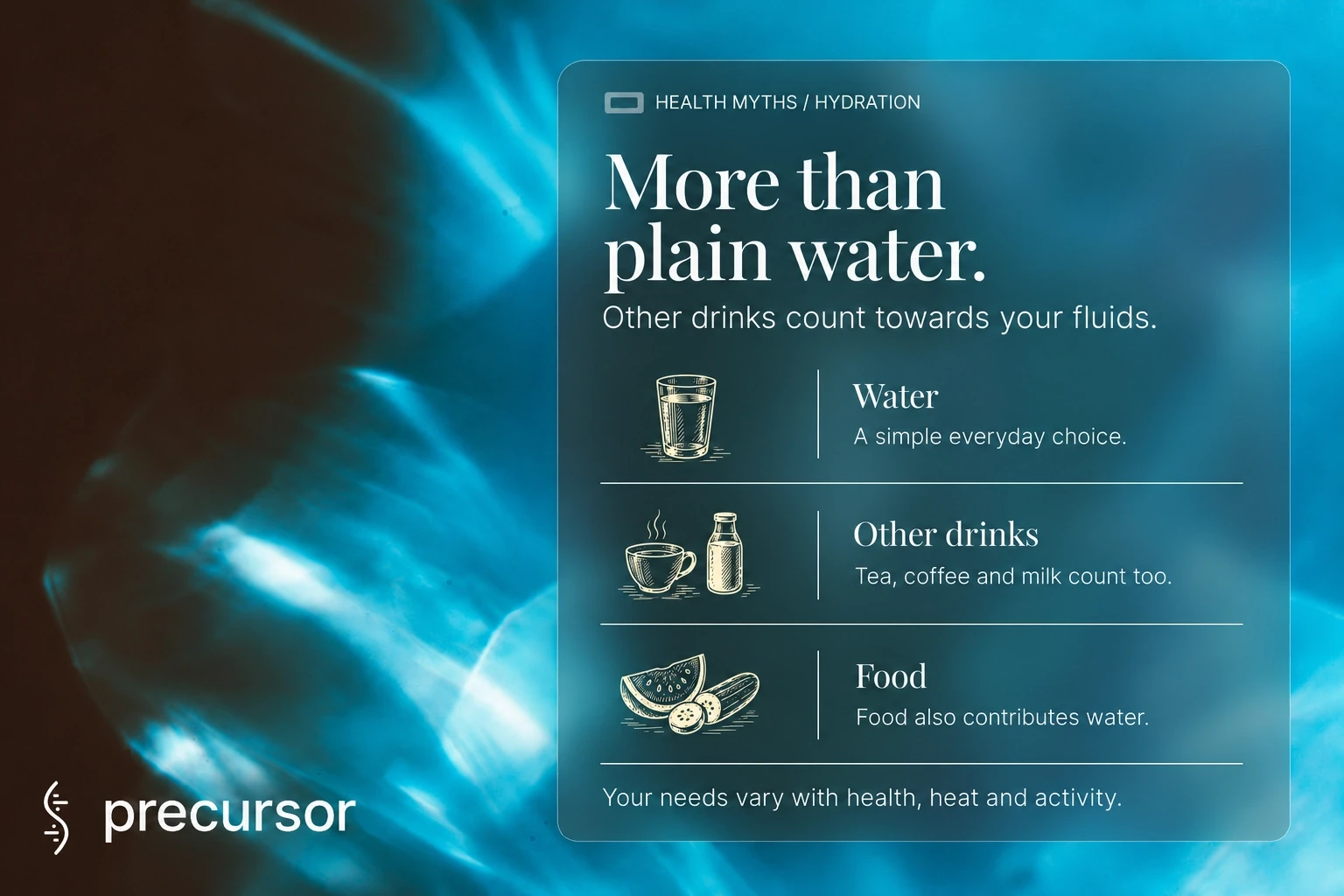
Australia's guidelines suggest about 2.1 litres of fluids a day for women (about 8 cups) and 2.6 litres for men (about 10 cups). The catch is that tea, coffee, milk and other drinks all count, and food adds roughly another 20% on top. (2)
So the number is roughly right. The “it must be plain water” part isn't. If you have a heart or kidney condition, follow your doctor's fluid advice instead.
2. “You need 10,000 steps a day”
Verdict: myth (but keep walking)
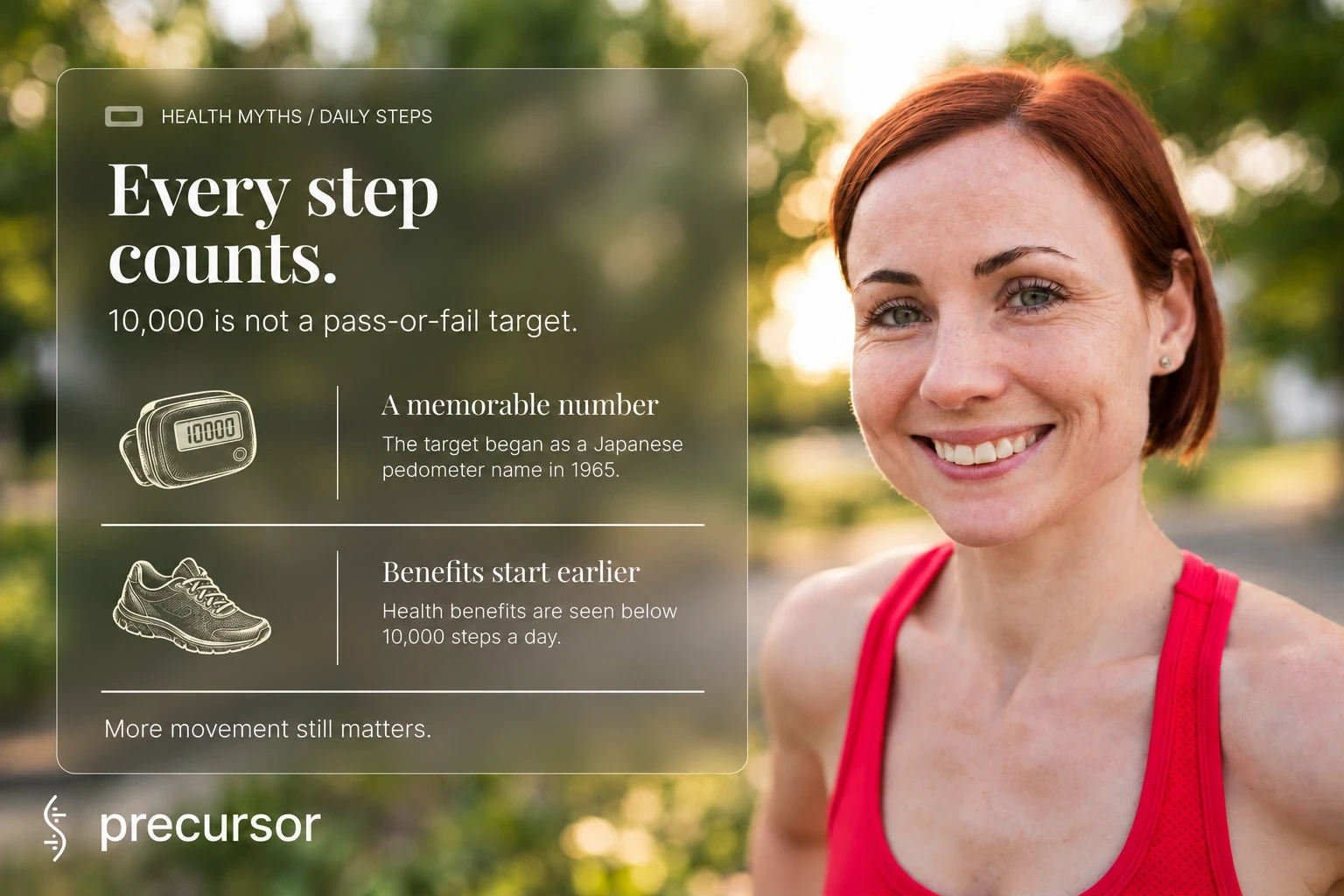
The 10,000 figure took off with a 1965 Japanese pedometer called the manpo-kei, which translates as “10,000 steps meter”. It was a catchy product name, not a research finding. (3)
When researchers finally tested it, a 2019 study of 16,741 older women found the lower risk of death levelled off at about 7,500 steps a day. (3) A larger 2022 analysis found the benefit plateaued at about 6,000 to 8,000 steps for adults over 60, and 8,000 to 10,000 for younger adults. (4)
More movement is still good. You just don't fail the day at 9,999.
Everyday movement also features in the daily routines of the world's oldest people, alongside a few more surprising habits.
3. “Cracking your knuckles causes arthritis”
Verdict: myth
Dr Donald Unger was told as a child that knuckle cracking would give him arthritis. So he cracked the knuckles of his left hand, and never his right, for 60 years. (5)
Neither hand developed arthritis, and he won an Ig Nobel Prize in 2009 for his dedication. (5) The pop is gas bubbles in the joint fluid, not your bones grinding.
Your friends and family may still find it annoying. That part is true.
4. “You only use 10% of your brain”
Verdict: myth
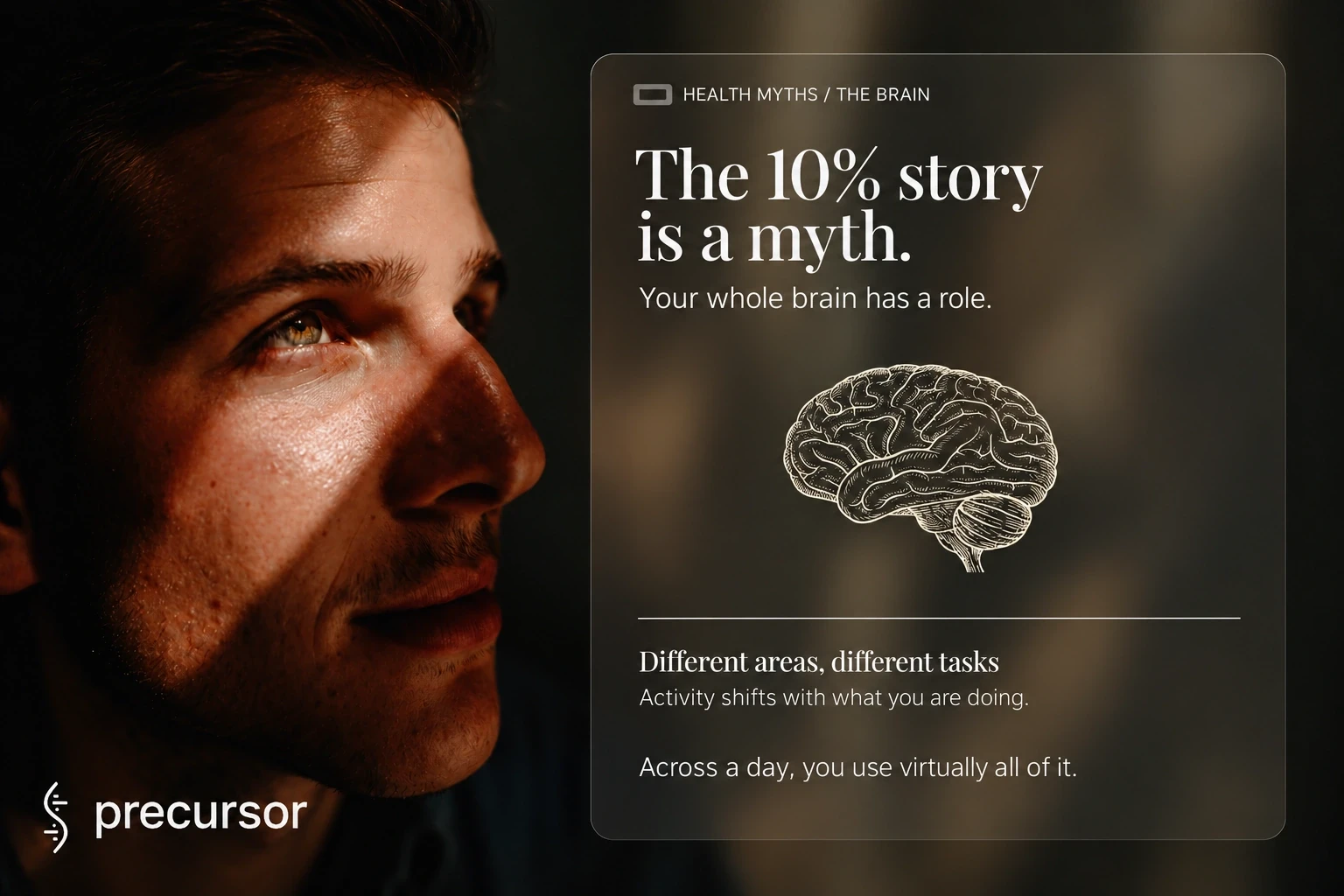
Brain imaging studies, including MRI and PET scans, show no dormant areas of the brain. Different areas are active at different times, but over a day you use virtually all of it. (1)
The myth probably started with self-improvement experts in the early 1900s. It's also the plot of more than one sci-fi film. (1)
5. “You lose most of your body heat through your head”
Verdict: myth
The idea goes back to an old US Army survival manual, which claimed people lose 40 to 45% of their body heat through their heads. (6)
Later research found that any uncovered part of the body loses heat roughly in proportion to its surface area. Your head isn't special. It's just usually the bit sticking out of your jacket. (6)
A beanie still helps, as would gloves, or long pants.
6. “Shaving makes hair grow back thicker and darker”
Verdict: myth
This was tested as far back as a 1928 clinical trial. Hair that grew back after shaving was no darker, no thicker and no faster than unshaved hair. (1)
Regrowth can feel coarser because the cut hair has a blunt tip instead of a fine, tapered one. It just isn't actually thicker.
7. “Sugar makes kids hyperactive”
Verdict: myth
At least 12 double-blind randomised trials have looked at children on diets with different amounts of sugar. None found any difference in behaviour, including in children with ADHD. (7)
The twist is in the parents. In one study, parents who were told their child had sugar rated them as more hyperactive, even when the drink was sugar-free. (6)
It may be the party, not the cake.
8. “Carrots help you see in the dark”
Verdict: half true
During the Blitz, British pilot John Cunningham, nicknamed “Cat's Eyes”, shot down German aircraft at night using a new and top-secret radar. To keep the radar quiet, Britain promoted the story that pilots ate lots of carrots. (8)
The Ministry of Food ran with it, with posters claiming carrots “help you to see in the blackout”. (8)
The true part is that carrots contain beta-carotene, which your body turns into vitamin A, and a lack of vitamin A can cause poor night vision. If you already get enough, though, extra carrots won't give you night vision. (8)
9. “Going out in the cold will give you a cold”
Verdict: myth
Colds are caused by viruses. More than 200 different viruses can cause one, and rhinoviruses are the most common. (9) They spread through droplets from coughs and sneezes, and from touching contaminated surfaces.
As Johns Hopkins puts it, “cold weather or being chilled doesn't cause a cold.” (9) Colds are more common in winter, partly because people spend more time indoors together.
So go outside with wet hair if you want. Just wash your hands afterwards.
10. “Your metabolism crashes in your 30s”
Verdict: myth
A 2021 study of more than 6,600 people from 29 countries found that energy expenditure, adjusted for body size, held steady from about 20 to 60. It only started to decline after 60, by about 0.7% a year. (10)
Midlife weight gain is real for many people. The research suggests a slowing metabolism isn't the main reason. (10) For more on how your body changes with age, see The Age You Peak at Everything.

Why do these myths stick?
Most of them have something going for them: a round number, a memorable story or a grain of truth. Eight glasses and 10,000 steps are easy to remember. “Cat's Eyes” is a better story than radar.
The useful habit is asking where a health “fact” came from, and whether anyone actually tested it.
How do you find out what's true for you?
General rules are a starting point, but your own body is the more interesting data set.
Have blood results handy? Try our blood-test biological age calculator. Otherwise, explore our biological age calculator without a blood test. These offer different kinds of estimates, rather than a verdict on your health.
This article provides general information and does not replace individual medical advice.
Frequently asked questions
How much water should you drink a day in Australia?
Australian guidelines suggest about 2.1 litres of fluids a day for women (about 8 cups) and 2.6 litres for men (about 10 cups). All drinks count, not just plain water, and food provides extra water on top. People with heart or kidney conditions should follow their doctor's advice. (2)
Do you really need 10,000 steps a day?
No. The 10,000 figure came from a 1960s Japanese pedometer name. Research suggests the benefits level off at about 6,000 to 8,000 steps a day for adults over 60, and 8,000 to 10,000 for younger adults. (3, 4)
Does cracking your knuckles cause arthritis?
There's no good evidence that it does. One doctor cracked the knuckles of only one hand for 60 years and found no arthritis in either hand. The popping sound comes from gas bubbles in the joint fluid. (5)
Sources
Vreeman and Carroll, BMJ (via ScienceDaily)
Medical myths even doctors believe, 2007NHMRC Nutrient Reference Values (Eat for Health)
WaterHarvard Health Publishing
10,000 steps a day, or fewer?, 2019Paluch and colleagues
Daily steps and all-cause mortality: a meta-analysis of 15 international cohorts, The Lancet Public Health, 2022Live Science
Knuckle-cracking gets (Ig) Nobel Prize, 2009Science Media Centre
Medical myths for the festive season, 2008Science Norway
Where the carrot myth comes fromJohns Hopkins Medicine
Common coldDuke University
Metabolism changes with age, just not when you might think, 2021