The Daily Routines of the World's Oldest People
The world's oldest people had gloriously odd routines, from baked beans at breakfast to a kilo of chocolate a week. Here's what they did, which habits research backs, and where luck comes in.
Written by: Gareth Shelwell
Read time: 8 minutes
The question every supercentenarian gets asked
Every time someone becomes the world's oldest person, a reporter asks the same question. What's your secret?
The answers are rarely what you'd expect. Fish and chips. Three yoghurts a day. Never arguing with anyone. And a kilo of chocolate a week, which we'll get to.
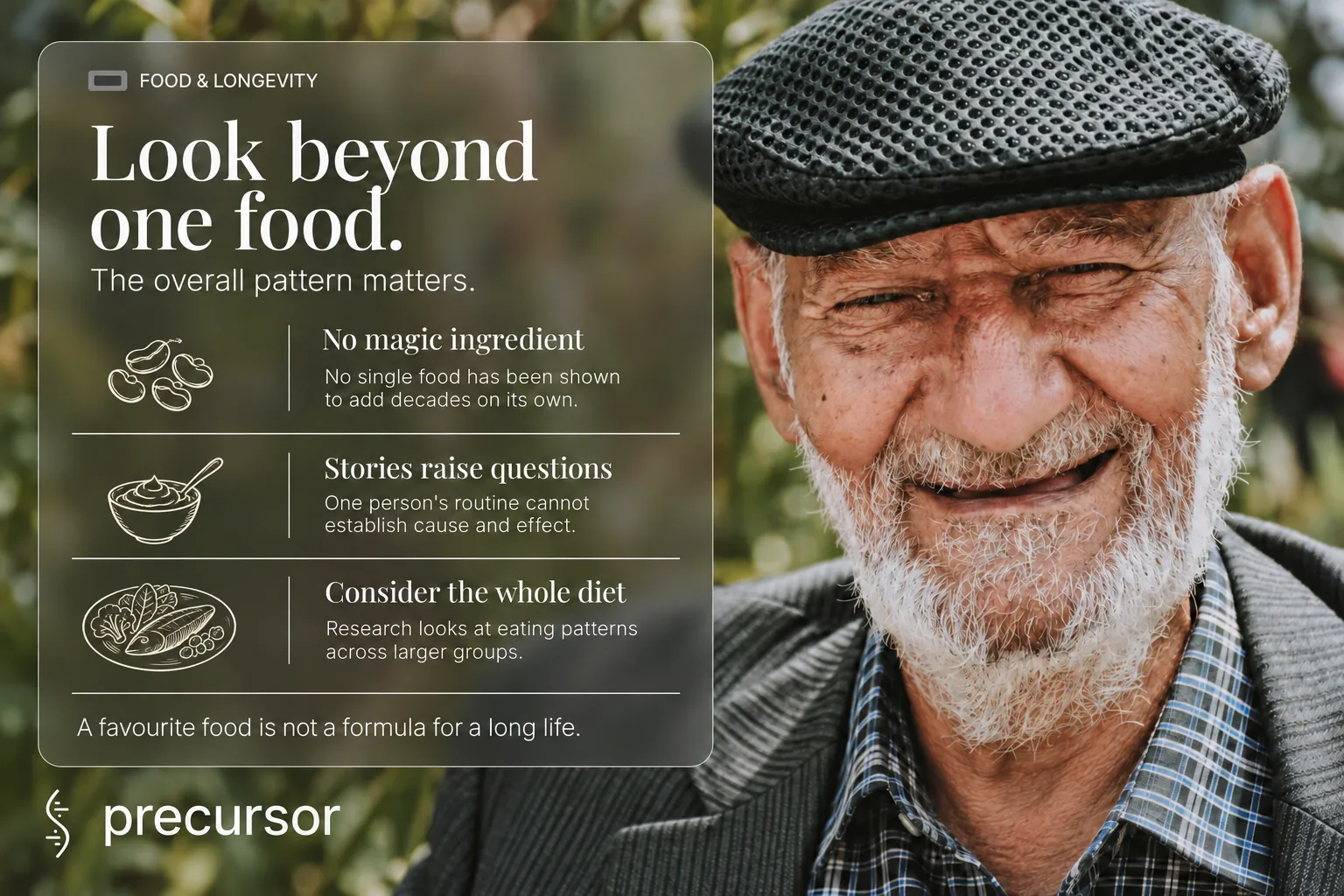
So is there a secret? Not one single secret. No food or habit on this list has been shown to add decades on its own. But line their routines up side by side and a few patterns keep popping up. Those patterns match what longevity research has found in much larger groups of people.
Here are eight of the most remarkable routines on record, and what the science says about each.
What to know
Australia's oldest person, Ken Weeks, turns 113 on 5 October 2026. He's eaten baked beans for breakfast for more than 30 years. (1, 2)
Jeanne Calment is the oldest verified person ever. She lived to 122 years and 164 days and cycled until she was 100. (3)
The habits these supercentenarians share are mostly unglamorous: moving every day, staying close to people and keeping the mind busy.
One person's routine can't predict what will work for you. Genes and plain luck play a real part. (4)
Who counts as one of the world's oldest people?
Anyone aged 110 or over is called a supercentenarian. Ages can be exaggerated, so groups like LongeviQuest and the Gerontology Research Group check claims against records before accepting them. That's why you'll see the word “verified” a lot. (2, 5)
At the time of writing, the world's oldest living person is Ethel Caterham of Surrey, England. She turned 117 on 21 August 2026 and is the first Briton ever to reach that age. (5)
Closer to home, Australia's oldest person is Ken Weeks of Grafton, New South Wales. Our list starts at his breakfast table. (2)
The breakfast club
1. Ken Weeks, Australia: baked beans, every morning
Asked how long he's been eating baked beans for breakfast, Ken told the ABC: “More than 30 years, I think.” For his 110th birthday, Heinz made a limited run of 300 cans featuring his portrait. (1, 6)
The habit started in his bachelor days, when he wanted a quick, filling meal. He has also admitted he “wasn't the best cook”. (6)
His family credits a plain, active life. “No drinking or smoking, and just a fairly plain food,” said his son Ian. His grandson Jason remembers him taking the stairs two at a time. Ken keeps it simple: “I've always been active.” (1)
2. Maria Branyas, Spain: three yoghurts a day
Maria Branyas lived to 117 years and 168 days. She ate three plain yoghurts a day with no added sugar, alongside plenty of fish and olive oil. She didn't smoke or drink. (7)
Researchers at the University of Barcelona studied her genes, gut bacteria and more. They found her gut was dominated by Bifidobacterium, bacteria generally considered beneficial. They also found protective genetic variants they'd never seen before. (7)
3. John Tinniswood, UK: fish and chips on Fridays
John Tinniswood of Liverpool was the world's oldest man until he died in 2024. He followed no special diet, never smoked, rarely drank and had fish and chips every Friday. (8)
His advice was moderation: “If you drink too much or you eat too much or you walk too much, if you do too much of anything, you're going to suffer eventually.” (8)
What the research says
Nutrition researchers usually look at overall eating patterns rather than star ingredients, and no single food has been shown to add decades.
Ken's beans do have some backing, though. A study of older people from several ethnic backgrounds found higher legume intake was the most protective dietary predictor of survival. Tinned baked beans come with added salt and sugar, so the label is worth a glance. (9)
Maria's yoghurt is more of an open question. Her researchers said they couldn't confirm her healthy gut bacteria were down to the yoghurt. They also warned that one person's results should be read with caution. (7)
Did they actually exercise?
4. Tomiko Itooka, Japan: mountains, in trainers
Tomiko Itooka lived to 116. She loved bananas and started her day with Calpis, a sweet, yoghurt-style Japanese drink. That's not the headline, though. (10)
In her 70s, she climbed Mount Ontake, all 3,067 metres of it, twice. In trainers. Her guide was famously surprised she hadn't worn hiking boots. At 100, she walked up the stone steps of Ashiya Shrine without a cane. (10)
5. Jeanne Calment, France: cycling to 100
Jeanne Calment holds the record for the longest verified human life. Over the years she fenced, swam, played tennis, went roller skating and climbed mountains. She rode a bike until she was 100. (3)
Her later routine ran like clockwork. She woke at 6:45, prayed, then stretched in her armchair. She napped for two hours in the afternoon, spent time with friends and was in bed by 10. (3)
What the research says
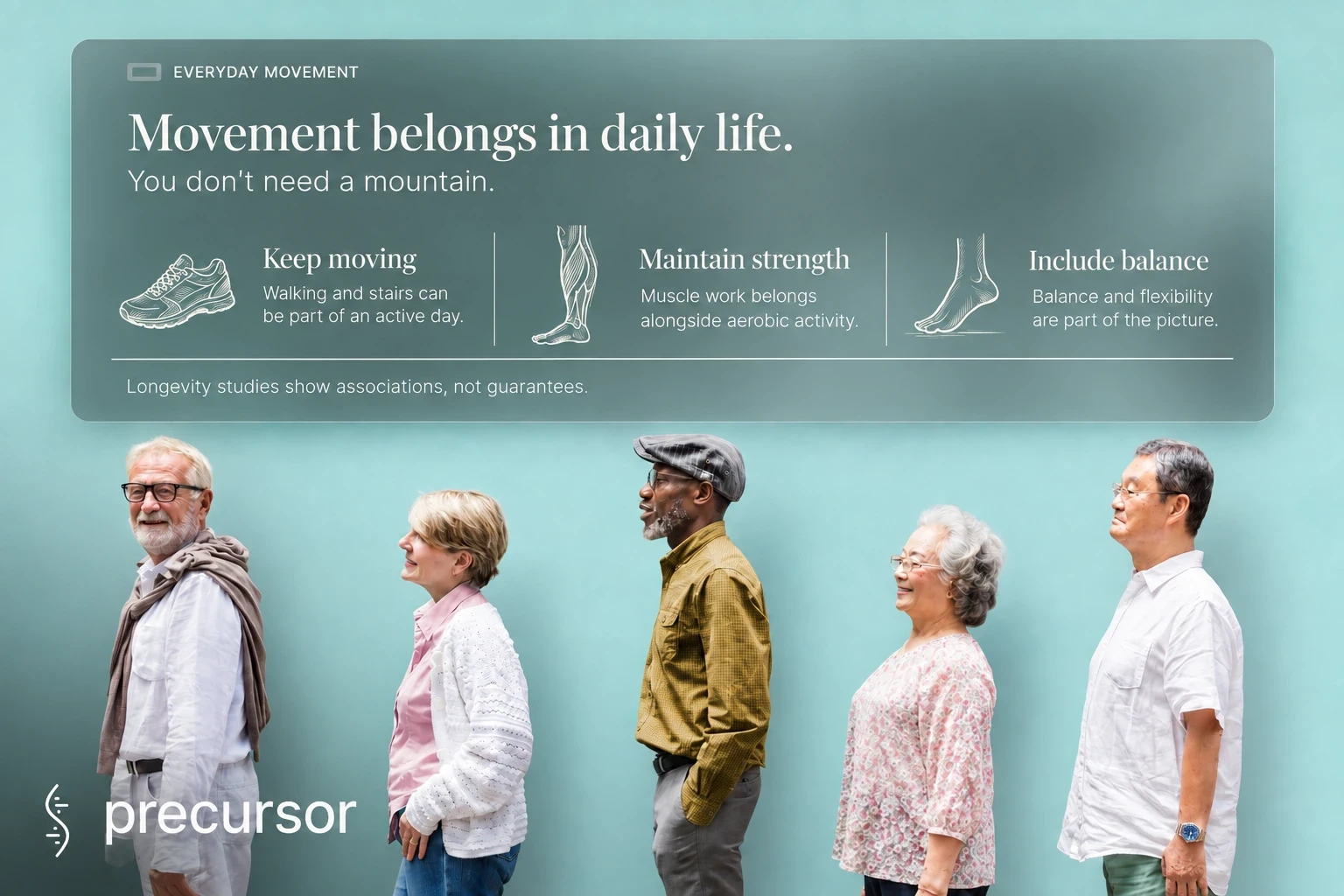
You don't need a mountain. A 2022 analysis of 15 studies and nearly 50,000 people looked at daily steps. For adults aged 60 and over, the lower risk of early death levelled off at about 6,000 to 8,000 steps a day. That's well short of the famous 10,000. (11)
Australia's guidelines suggest people aged 65 and over aim for at least 30 minutes of moderate activity on most, preferably all, days. They also recommend strength, balance and flexibility work. Climbing stairs counts as strength, so Ken's two-at-a-time habit was right on brief. (12)
These studies show associations, so they can't prove steps alone explain the difference. Still, movement comes up again and again in longevity research. If you're curious where your own fitness sits, our VO₂ max calculator can give you a rough estimate.
Does attitude really matter?
6. Ethel Caterham, UK: never argue
The world's oldest living person has a refreshingly simple philosophy. “Never arguing with anyone, I listen and I do what I like,” she said in 2025. (13)
Ethel moved to India at 18 to work as a nanny, later lived in Hong Kong and drove her late husband's car until she was 97. Whether “do what I like” is a longevity strategy or just excellent life advice, it's hard to argue with. Which is presumably the point. (5, 14)
7. Kane Tanaka, Japan: maths, Othello and “Now”
Kane Tanaka lived to 119. She was up at 6am, and she spent her afternoons on maths problems and calligraphy. She also became an Othello expert and often beat the staff at her rest home. (15)
When she was named the world's oldest person in 2019, she was asked about the happiest moment of her life. Her answer was one word: “Now.” (15)
8. Sister André, France: working until 108
Lucile Randon, known as Sister André, lived to 118. She worked until she was 108 and was clear about why it mattered: “Working … makes you live.” (16)
What the research says
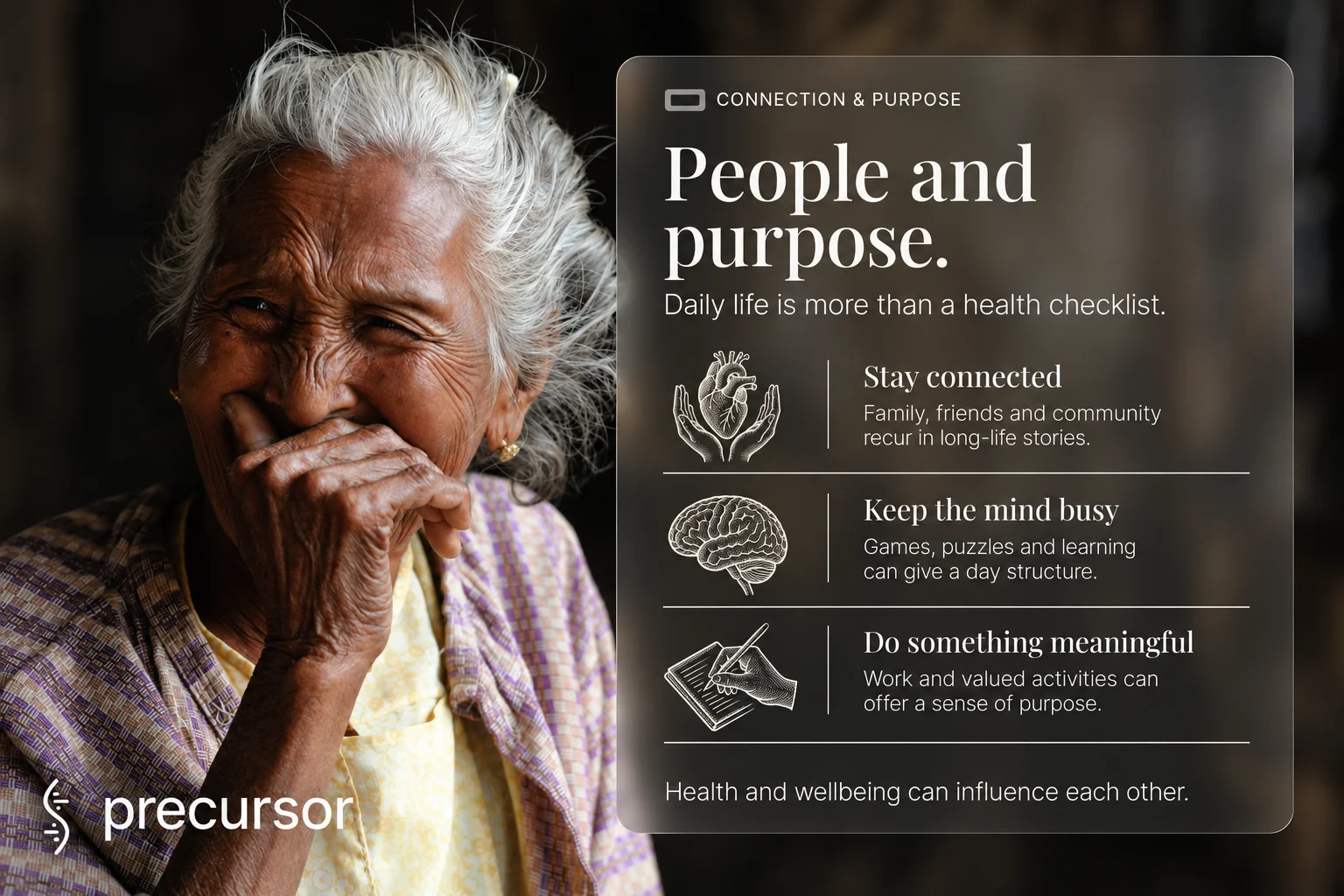
Relationships show up strongly. A 2010 review of 148 studies covering more than 300,000 people looked at social relationships. People with stronger social ties had a 50% greater likelihood of survival over the study periods. The researchers compared the size of that effect to quitting smoking. (17)
Optimism appears too. A 2019 study of more than 71,000 people compared the most and least optimistic. The most optimistic had an 11 to 15% longer lifespan and 50 to 70% greater odds of reaching 85. Research in Americans over 50 has also linked a stronger sense of purpose with lower mortality. (18, 19)
The catch is that these are associations. Healthier people may simply find it easier to socialise, stay positive and keep working, so cause and effect probably run both ways.
The treats section you scrolled down for
Jeanne Calment sometimes ate a kilogram of chocolate a week and had a small glass of port after meals. Sister André had a glass of wine and a piece of chocolate every day. Kane Tanaka loved soda and chocolate. (3, 15, 16)
Calment also smoked from 21 until 117. She only stopped because failing eyesight made lighting up difficult. Please don't take notes on that part. (3)
What the research says
Australia's alcohol guidelines recommend healthy adults have no more than 10 standard drinks a week and no more than 4 on any one day. The less you drink, the lower your risk of alcohol-related harm. (20)
Chocolate gets a mixed verdict. A US trial gave 21,442 adults cocoa flavanol supplements. The capsules didn't significantly reduce total cardiovascular events, although deaths from cardiovascular disease were 27% lower. Those were concentrated capsules, not a block of milk chocolate. (21)
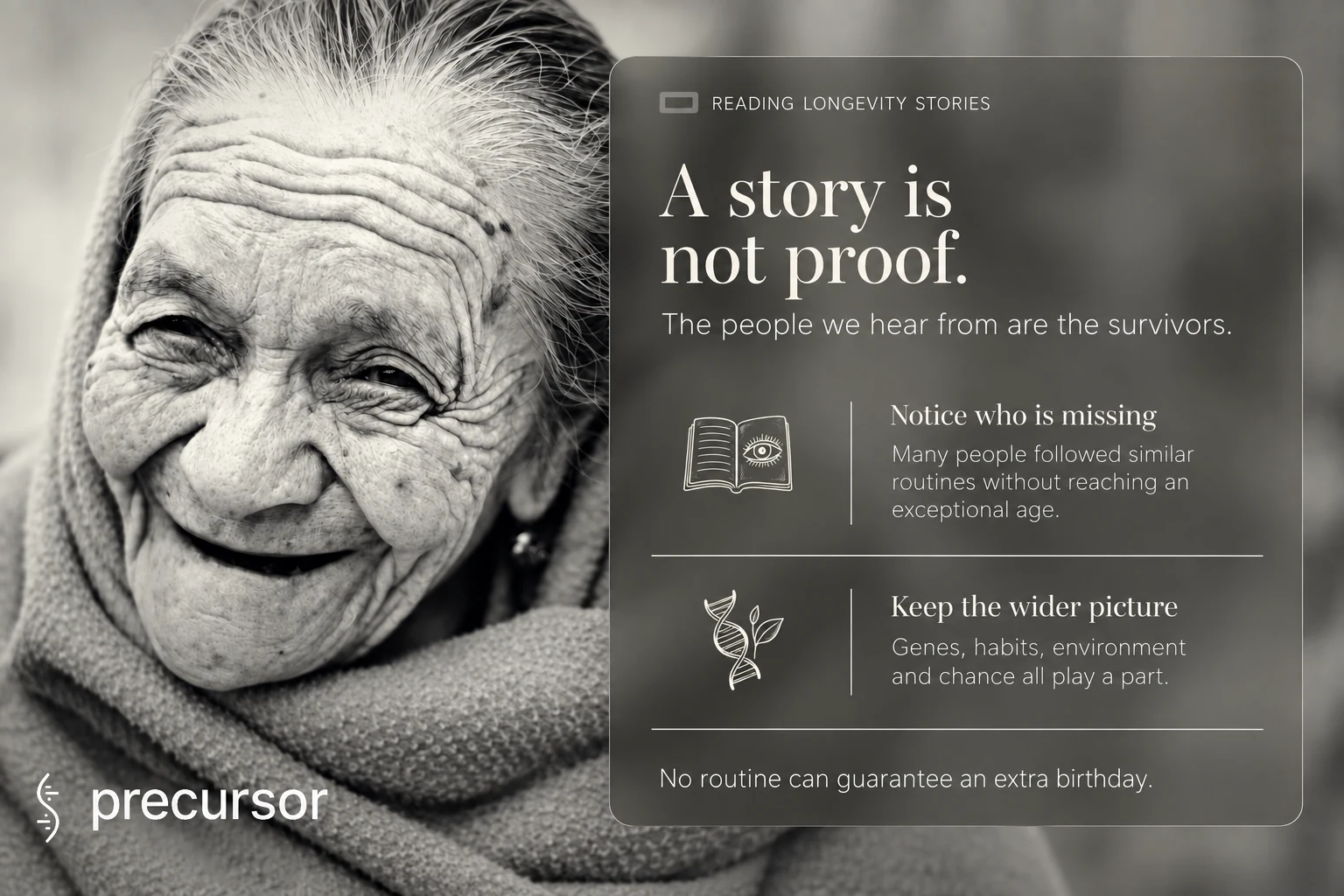
Every “secret to long life” story also has a bias built in. We only ask the people who made it. Plenty of people ate chocolate every day and didn't reach 110.
So was it just luck?
John Tinniswood thought so. “It's pure luck,” he said. “You either live long or you live short, and you can't do much about it.” (8)
He was partly right. A 2018 analysis of family trees covering more than 400 million people looked at how much genes explain. It estimated they account for no more than about 7% of the variation in lifespan, well below earlier estimates of 15 to 30%. For most people, what happens outside the genes counts for far more, including habits, environment and chance. (4)
The very oldest may be different. The team that studied Maria Branyas described extreme longevity as roughly “half and half” between what we inherit and what we do. (7)
The habits worth borrowing
Take away the beans, bananas and port, and the habits they share are pleasingly ordinary. Most of them moved every day, often without calling it exercise. They stayed connected to family, faith or community. They kept their minds busy with work, puzzles or games. Most ate fairly plainly, with a favourite treat or two.
None of that guarantees an extra birthday. But larger studies link these same habits with healthier ageing, which makes them sensible ones to copy.
None of these eight ever saw a biological age estimate. If you're curious how your body is tracking against the calendar, try our biological age calculator. It's an estimate, not a verdict, and it makes the most sense alongside your other health information.
This article provides general information and does not replace individual medical advice.
Frequently asked questions
Who is the oldest person in the world right now?
Ethel Caterham of Surrey, England, is the world's oldest living person as of September 2026. She was born on 21 August 1909 and turned 117 on 21 August 2026, which makes her the first Briton ever to reach that age. (5)
Who is the oldest person who ever lived?
Jeanne Calment of Arles, France, holds the record for the longest verified human life. She was born on 21 February 1875 and died on 4 August 1997, aged 122 years and 164 days. She rode a bike until she was 100. (3)
Who is the oldest person in Australia?
Ken Weeks of Grafton, New South Wales, is Australia's oldest living person. He was born on 5 October 1913 and turns 113 on 5 October 2026. He's also eaten baked beans for breakfast for more than 30 years. (1, 2)
Sources
ABC News
Australia's oldest man, Ken Weeks, celebrates 110th birthday in Grafton aged care home, 2023Gerontology Research Group
Dora Caverson, the oldest known living woman in Australia, celebrated her 112th birthday, 2026Guinness World Records
Oldest person ever: 122-year-old Jeanne Calment's extraordinary life, 2024Ruby and colleagues
Estimates of the heritability of human longevity are substantially inflated due to assortative mating, Genetics, 2018Guinness World Records
World's oldest person Ethel Caterham becomes first-ever Brit to reach age 117, 2026Whiddon
Whiddon and Heinz Australia celebrate the nation's oldest man, 110-year-old Grafton resident Kenneth Weeks, 2023CBS News
She lived to be the world's oldest person. A new study credits genetic variants, and maybe her yogurt habit, 2025NBC News
The world's oldest man says the secret to his longevity is luck, plus regular fish and chips, 2024Darmadi-Blackberry and colleagues
Legumes: the most important dietary predictor of survival in older people of different ethnicities, Asia Pacific Journal of Clinical Nutrition, 2004Euronews
Meet Tomiko Itooka: the world's oldest person at 116 who loves bananas and scaling mountains, 2024Paluch and colleagues
Daily steps and all-cause mortality: a meta-analysis of 15 international cohorts, The Lancet Public Health, 2022Australian Government Department of Health, Disability and Ageing
Physical activity and exercise guidelines for older Australians (65 years and over)Associated Press via KSL
Never argue: 115-year-old British woman, now the world's oldest, gives her recipe to long life, 2025BBC Science Focus
Who is the oldest person in the world?, 2026CBS News
World's oldest person, Kane Tanaka, dies in Japan at age 119, 2022Yahoo News
Sister André, the world's oldest person, has died at 118, 2023Holt-Lunstad and colleagues
Social relationships and mortality risk: a meta-analytic review, PLOS Medicine, 2010Lee and colleagues
Optimism is associated with exceptional longevity in 2 epidemiologic cohorts of men and women, PNAS, 2019Alimujiang and colleagues
Association between life purpose and mortality among US adults older than 50 years, JAMA Network Open, 2019National Health and Medical Research Council (NHMRC)
Alcohol: Australian guidelines to reduce health risks from drinking alcoholSesso and colleagues
Effect of cocoa flavanol supplementation for the prevention of cardiovascular disease events: the COSMOS randomized clinical trial, American Journal of Clinical Nutrition, 2022