The Age You Peak at Everything
Your brain is fastest at 18, your grip is strongest in your 30s and your vocabulary may not peak until your late 60s. Here's the full timeline, and why it isn't all downhill.

Written by: Gareth Shelwell
Read time: 6 minutes
Is it really all downhill after 30?
Somewhere around your 30th birthday, someone will tell you it's all downhill from here. They're only partly right.
You don't have one peak. You have dozens, spread across your whole life. Your brain processes information fastest at around 18. Your muscles and bones hit their best in your late 20s and 30s. Reading other people's emotions tops out in your 40s or 50s, and your vocabulary may keep growing into your late 60s. (1, 3)
“At any given age, you're getting better at some things, you're getting worse at some other things, and you're at a plateau at some other things,” said Joshua Hartshorne, co-author of one of the largest studies on the topic. (3)
Here's the full timeline, from your first birthday to your 70s.
What to know
You don't have one peak. Different abilities top out anywhere from your first birthday to your 70s. (1, 2)
Raw processing speed peaks around 18, while vocabulary keeps growing until the late 60s or early 70s. (1, 3)
In the Berlin Marathon, everyday runners were fastest at 32 (women) and 34 (men). (4)
These are averages across large groups. Training can shift your own curve, even in your 90s. (5)

The speed years: birth to your mid-20s
Age 1: metabolism
Your metabolism peaks before you can walk. By their first birthday, babies burn calories about 50% faster for their body size than adults do. It then gradually slows until about age 20. (2, 6)
Toddlers, in other words, are tiny furnaces.
Age 18: processing speed
Raw processing speed is how quickly you take in and work with new information. It peaks around 18 or 19 and starts to decline almost straight away. Enjoy it while it lasts. (3)
Age 24: gaming reflexes
A study of 3,305 StarCraft II players aged 16 to 44 found their in-game reaction speed started slowing at around 24. The researchers titled their paper “Over the hill at 24”. (7)
The good news is that older players made up for it with keyboard shortcuts and simpler strategies. Experience can close some of the gap. (7)
Age 25: short-term memory and explosive power
Short-term memory peaks around 25, levels off, then starts to decline around 35. (3)
Explosive sports peak early too. A review of elite athletes found peak ages for sprint and power events ranged from about 20 in swimming to about 27 in throwing events. (8)
The strength years: your late 20s and 30s
25 to 30: bone mass
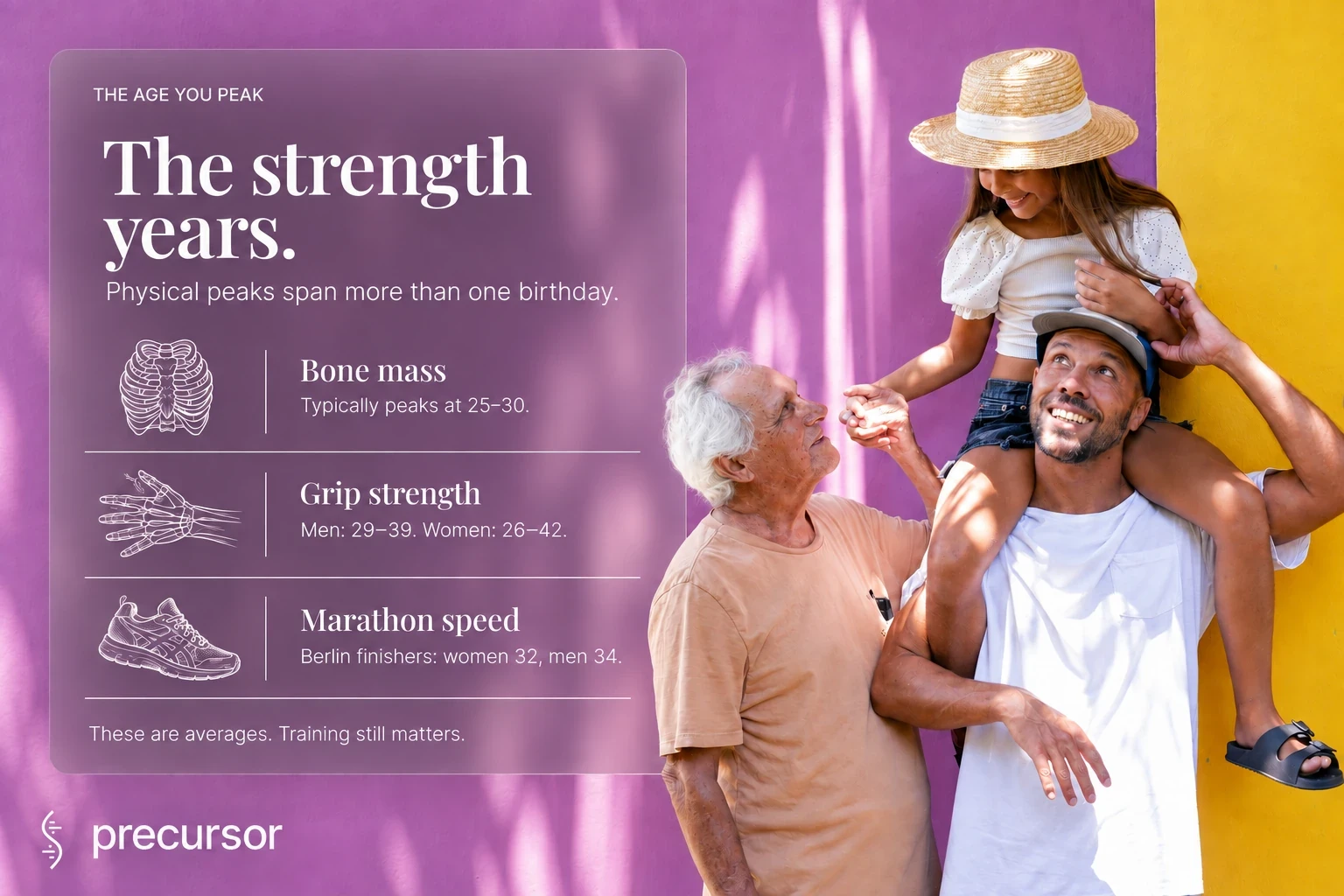
Most people reach their peak bone mass between 25 and 30. Until about 40, the bone your body breaks down is fully replaced. After 40, less of it is. (9)
29 to 39: strength
Data from nearly 50,000 people in 12 British studies found grip strength peaked between 29 and 39 in men and between 26 and 42 in women. It then held steady through midlife before declining. (10)
Early 30s: faces and numbers
Recognising faces peaks in the early 30s. Working memory for numbers, like holding a phone number in your head, peaks in the early to mid-30s. (3, 11)
32 and 34: marathon running
Everyday runners peak later than you might think. An analysis of 387,222 Berlin Marathon finishers found women ran their fastest at 32 and men at 34. (4)
Even better, women aged 60 to 64 and men aged 55 to 59 were still running at about 90% of their peak speed. (4)
Among elite athletes, the longer the event, the later the peak. For ultra-distance cycling, it's about 39. (8)
What the research says
Muscle responds to training at almost any age. In a 1990 study, 10 frail nursing home residents aged around 90 did eight weeks of strength training. Among the nine who finished, strength rose by 174% on average, and a measure of walking speed improved by 48%. (5)
It was a small study, so those exact numbers won't apply to everyone. Still, it showed that muscle can respond to training even in your 90s.
Australia's guidelines recommend muscle-strengthening activities on at least two days a week for adults. For people 65 and over, they suggest strength activities to help maintain muscle and bone, such as weight training and climbing stairs. (12, 13)
If you'd like a sense of where your fitness sits now, our VO₂ max calculator can give you a rough estimate.
The people years: your 40s and 50s
40s and 50s: reading emotions
Your ability to read other people's emotions peaks in your 40s or 50s. That's handy for meetings, negotiations and working out what your teenager actually means. (3, 11)
Around 50: happiness turns the corner
This one isn't a peak. It's the bottom of a curve. A study across 145 countries found that well-being follows a U-shape, dipping to a low point around age 50 before rising again. (14)
So if your late 40s feel like a slog, the data suggests things tend to improve from there.
The word years: your 60s and 70s

Late 60s to early 70s: vocabulary
Vocabulary is the late bloomer. In the large online study, it peaked in the late 60s or early 70s. Older test data had put this peak in the late 40s, so the newer research pushed it out by about two decades. (3)
Crossword fans, your best years may still be ahead.
After 60: metabolism finally slows
This myth is worth busting. Your metabolism doesn't crash in your 30s or 40s. A 2021 study of more than 6,600 people from 29 countries found that energy expenditure, adjusted for body size, held steady from 20 to 60. (2, 6)
After 60 it declines by about 0.7% a year. By 90, people need about 26% fewer calories a day than in midlife. (6)
What can't these peak ages tell you?
These numbers are averages across large groups. Your own curve can sit well above or below them.
Most of this research compares different people at different ages, rather than following the same people for decades. That means differences between generations can shape the results.
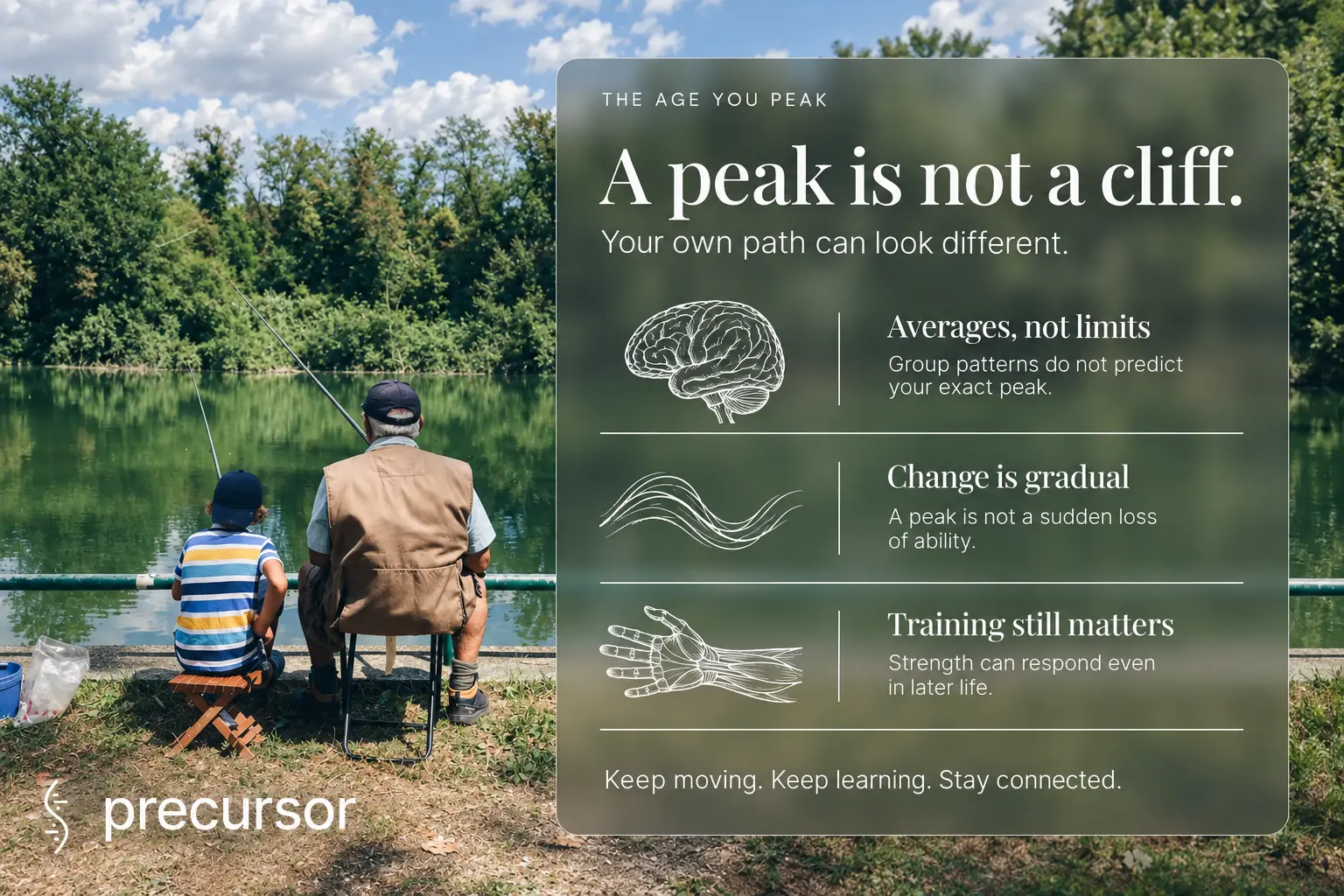
A peak also isn't a cliff. Most declines are gradual, as the 90% marathon figure shows.
How do you stay near your peak for longer?
Put the timeline together and a few habits keep coming up. Do some strength training twice a week. Keep moving. Keep learning new words, skills and games. Stay close to people.
None of this stops the clock. But the research suggests several of these abilities respond to how you use them, at almost any age.
Your birthday only tells you one number. If you're curious how your body is tracking against it, try our biological age calculator. It's an estimate rather than a verdict, and it's most useful alongside your other health information.
This article provides general information and does not replace individual medical advice.
Frequently asked questions
What age are you physically strongest?
Data from nearly 50,000 people found grip strength peaked between 29 and 39 in men and between 26 and 42 in women. It held steady through midlife before declining. Strength still responds to training later on, even in your 90s. (5, 10)
At what age does your brain peak?
There's no single brain peak. Processing speed peaks around 18, short-term memory around 25 and face recognition in the early 30s. Reading emotions peaks in the 40s and 50s, and vocabulary in the late 60s or early 70s. (1, 3)
Does your metabolism slow down in your 30s?
Not according to a 2021 study of more than 6,600 people from 29 countries. Energy expenditure, adjusted for body size, stayed stable from about 20 to 60. It only began to fall after 60, by about 0.7% a year. (2, 6)
Sources
Hartshorne and Germine
When does cognitive functioning peak? The asynchronous rise and fall of different cognitive abilities across the life span, Psychological Science, 2015Pontzer and colleagues
Daily energy expenditure through the human life course, Science, 2021MIT News
The rise and fall of cognitive skills, 2015International Journal of Environmental Research and Public Health
The age-related performance decline in marathon running: the paradigm of the Berlin Marathon, 2019Fiatarone and colleagues
High-intensity strength training in nonagenarians: effects on skeletal muscle, JAMA, 1990Duke University
Metabolism changes with age, just not when you might think, 2021Thompson and colleagues
Over the hill at 24: persistent age-related cognitive-motor decline in reaction times in an ecologically valid video game task begins in early adulthood, PLOS ONE, 2014Allen and Hopkins
Age of peak competitive performance of elite athletes: a systematic review, Sports Medicine, 2015OrthoInfo, American Academy of Orthopaedic Surgeons
Healthy bones at every ageDodds and colleagues
Grip strength across the life course: normative data from twelve British studies, PLOS ONE, 2014British Psychological Society, Research Digest
Different mental abilities peak at different times of life, from 18 to 70+Australian Government Department of Health, Disability and Ageing
Physical activity and exercise guidelines for adults (18 to 64 years)Australian Government Department of Health, Disability and Ageing
Physical activity and exercise guidelines for older Australians (65 years and over)Blanchflower
Is happiness U-shaped everywhere? Age and subjective well-being in 145 countries, Journal of Population Economics, 2021