Understanding blood test results without reading too much into one number
Learn how reference intervals, trends, medicines and context shape blood test results, and when an abnormal result may need follow-up.

Written by: Gareth Shelwell
Read time: 8 minutes
The flag is usually the first thing you notice
A high or low flag can look more definite than it is. It shows how your number compares with the laboratory’s reference interval. It doesn’t provide a diagnosis. (3, 4)
Your reason for testing, symptoms, medicines, recent illness and related results help determine what the number means. A useful review looks at that context before deciding whether anything needs confirming or following up. (1, 3)
What to know
A reference interval is a comparison tool, not a perfect boundary between health and illness.
One mildly changed result can reflect ordinary biological variation, preparation or the laboratory process.
Related markers and previous results often explain more than one isolated flag.
If a symptom persists, a normal blood result doesn’t automatically close the question.
Start with the reason the test was ordered
The same result can carry different weight in different settings. A blood count ordered during a short viral illness answers a different question from a blood count used to monitor long-term treatment. A cholesterol result in a healthy young adult is read differently from the same value in someone with established cardiovascular disease. (1)
Before looking at individual numbers, ask what the test was intended to explore. Was it checking a symptom, monitoring a condition, reviewing medicine safety or establishing a baseline? Was the panel targeted to one question, or part of a broader health assessment?
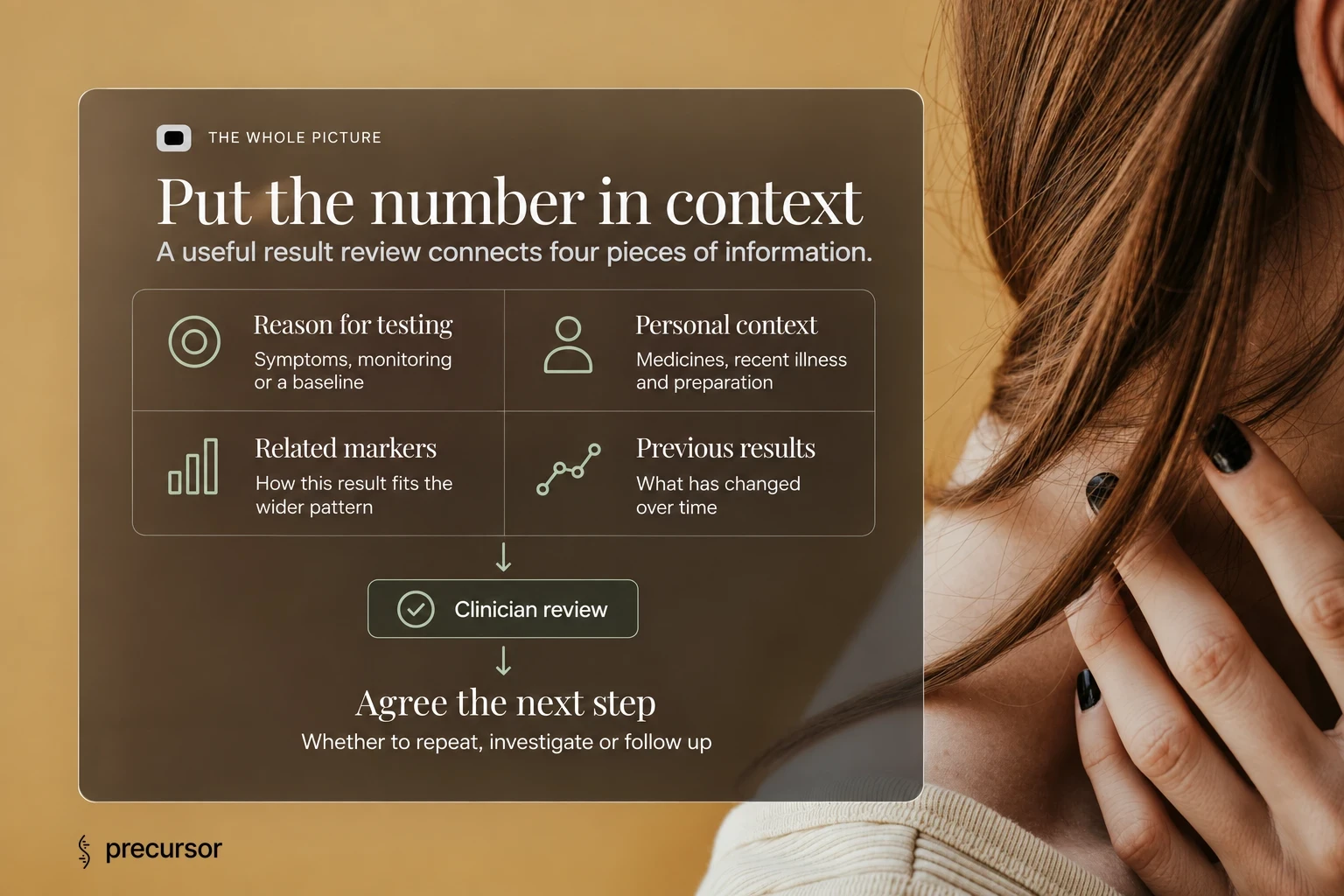
Start with why the test was ordered. Without that frame, it’s easy to read too much into a number.
What a reference interval means
The range beside your result comes from a reference group and the laboratory method used. It gives your clinician a useful comparison. (4, 5)
Healthy people can sit outside the interval, and people with an illness can sit inside it. The interval helps with interpretation. It does not draw a perfect line between health and illness. (4)
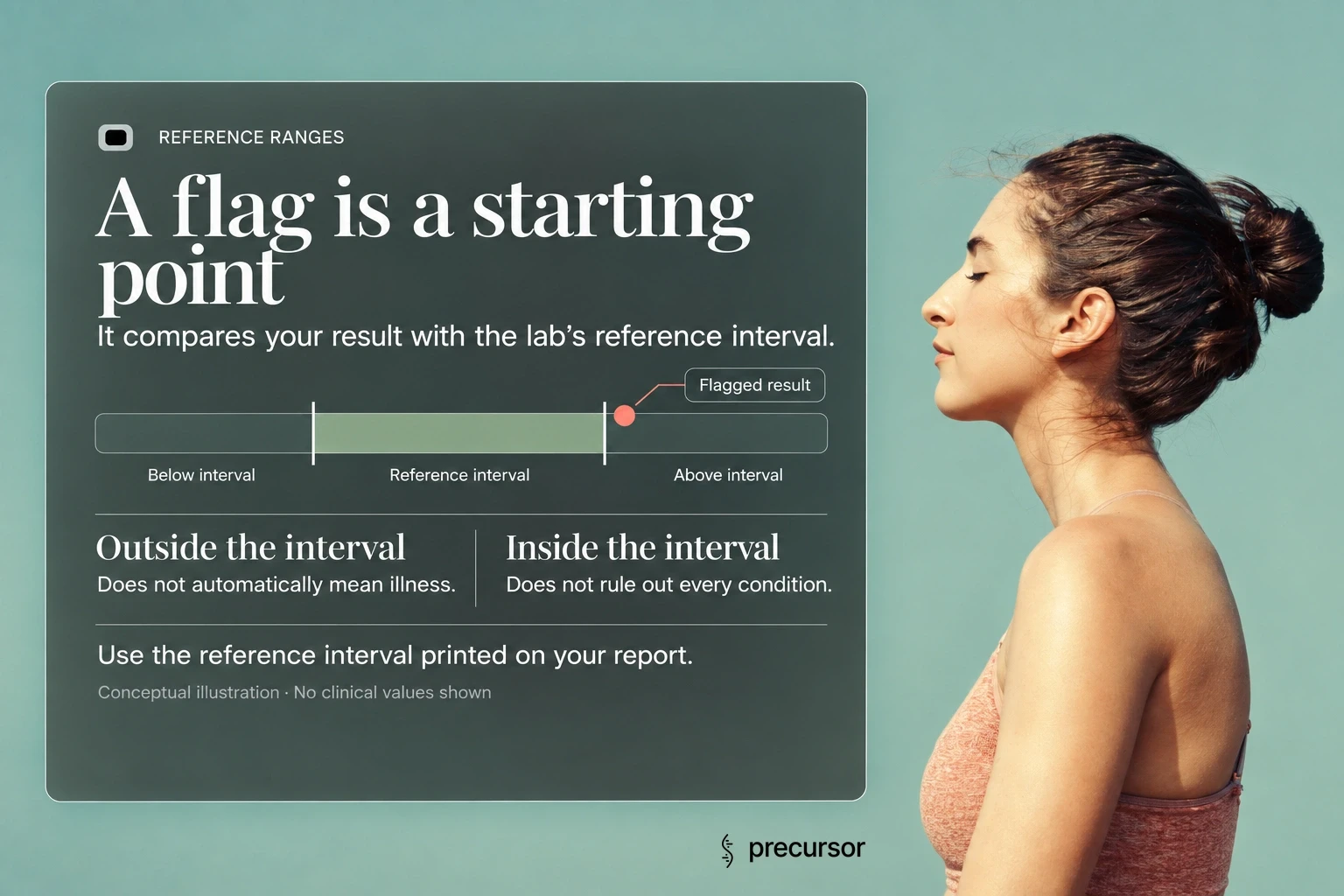
Intervals may differ between laboratories because methods and reference groups differ. Age, sex, pregnancy and other biological factors can change the appropriate comparison. Use the interval printed on your report rather than a range copied from another laboratory or a general website. (3, 6)
Reference intervals, diagnostic thresholds and treatment targets
These terms are sometimes treated as though they mean the same thing.
A reference interval is a laboratory comparison range. A diagnostic threshold is a value used as part of the criteria for a condition. A treatment target is a goal used in the care of someone with particular risks or a diagnosed condition. (5)
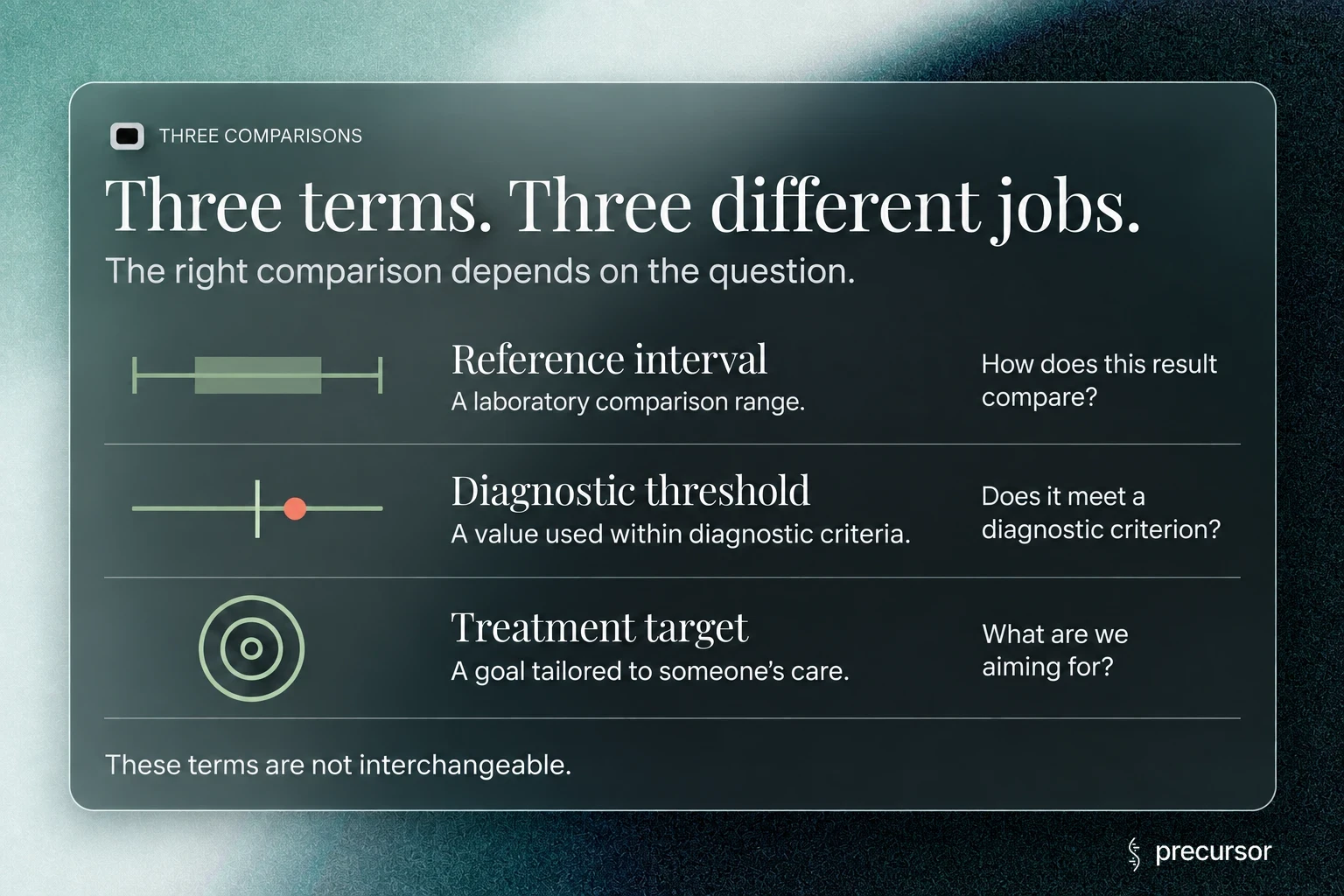
For example, a clinician assessing blood glucose may consider the test type, whether the sample was fasting, repeated measurements and recognised diagnostic criteria. A person already receiving treatment may have an agreed target shaped by their condition and circumstances.
The relevant standard depends on the question. This is one reason a generic “optimal range” found online can be misleading.
Why one abnormal result may not mean disease
Every measurement contains biological and analytical variation. Your body changes across the day and in response to food, hydration, exercise, sleep and illness. The collection and laboratory process also has a small amount of variation. (5)
A mildly changed result may reflect that ordinary movement. It may also be an early sign of something worth assessing. The size of the change, related markers, previous results, symptoms and known risks help the clinician decide which explanation is more plausible.
Sometimes the safest next step is a repeat test under clearer conditions. Repeating can show whether the result persists, returns to its usual range or moves in a meaningful direction.
Factors that can change blood results
Preparation matters for some tests. Eating can affect glucose and triglycerides. Hydration can influence the concentration of several blood components. Strenuous exercise can temporarily change muscle, liver-related and inflammatory markers. (2)
Medicines and supplements are also relevant. Biotin can interfere with some laboratory assays. (10) Iron, vitamin B12, hormones and other supplements can alter the measure they are intended to change. Prescribed medicines may affect kidney, liver, electrolyte or blood-cell results.
Tell the clinician what you take, including products bought without a prescription. Do not stop treatment simply to obtain a different result. Any change should be guided by the clinician responsible for that medicine.
Other useful context includes recent infection, vaccination, menstruation, pregnancy, alcohol intake, a long flight, a major change in diet and the time of collection. You don’t need to explain away every variation yourself. Sharing the context makes the result easier to interpret. (2)
Look for patterns across related tests
Blood panels often contain groups of related measures. A full blood count includes information about red blood cells, white blood cells and platelets. (9) Iron studies use several measures to describe iron storage and transport. Liver and kidney panels combine markers that reflect different aspects of those systems.
Clinicians look at the pattern because one result can clarify another. A red blood cell measure may be more informative when read beside haemoglobin, cell size and iron markers. A liver enzyme may be considered alongside other liver tests, medicines, alcohol and recent exercise. (7, 8)
This does not mean every result can be connected into one story. Some changes are unrelated. A careful interpretation allows more than one possibility until the evidence is clearer.
Trends can add context
A previous result can show whether a measure is stable, gradually changing or temporarily different. Trend information is especially useful when the same test has been repeated under comparable conditions.
Comparability still needs care. A different laboratory method, a changed medicine, weight change, pregnancy or an acute illness can alter the context. A graph may make a movement look dramatic because of its scale even when the absolute change is small.
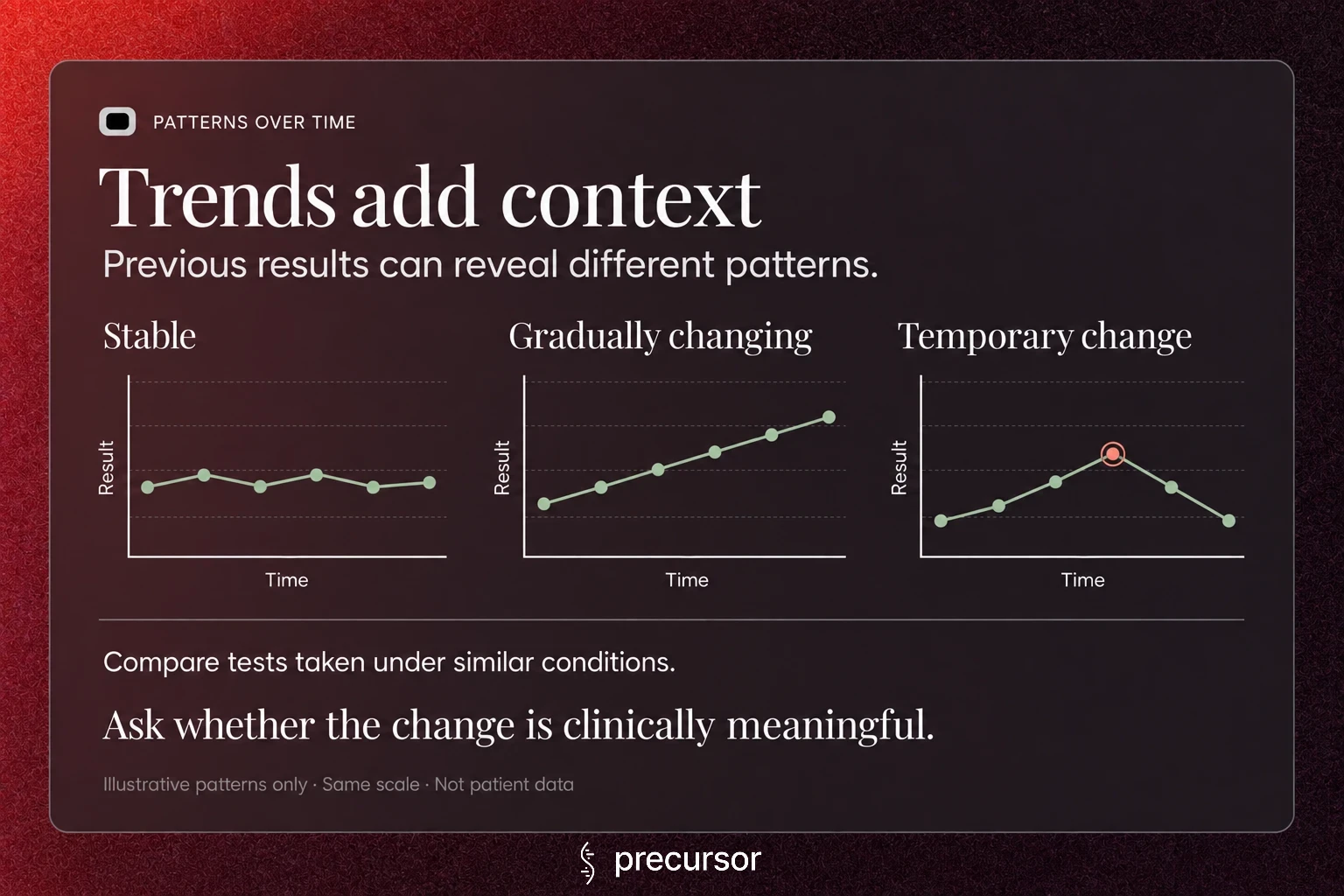
Ask whether the change is clinically meaningful, rather than relying on the direction alone. The answer may depend on how quickly it occurred and what is happening in related measures.
Common groups of blood tests
Full blood count
A full blood count describes the number and characteristics of blood cells. It can contribute to the assessment of anaemia, infection and some blood disorders. A changed result often has several possible causes, so symptoms and related measures matter. (8, 9)
Iron studies
Iron studies may include ferritin and measures of iron transport. Ferritin can reflect iron stores and can also rise with inflammation or illness. Menstruation, pregnancy, diet and gastrointestinal health can influence the assessment. (8)
Cholesterol and lipids
Lipids contribute to cardiovascular risk assessment. Their interpretation includes the balance of lipid measures and the person’s overall risk profile. Blood pressure, smoking, diabetes, family history and existing cardiovascular disease can change the recommended response. (8)
Glucose measures
Glucose tests can describe a current level or an average over a longer period, depending on the measure. Timing, food, medicines and some medical conditions affect interpretation. Diagnostic decisions usually follow defined criteria and may require confirmation. (8)
Liver-related tests
These tests measure substances associated with liver cells, bile flow and protein production. Alcohol, medicines, body composition, exercise and temporary illness may contribute to a change. The label “liver function tests” covers markers that do different jobs. (8)
Kidney-related tests
Kidney assessment may include creatinine, an estimated filtration rate, electrolytes and urine measures. Age, muscle mass, hydration and medicines can affect some results. A sustained pattern often matters more than one estimate. (8)
Thyroid tests
Thyroid assessment commonly begins with thyroid-stimulating hormone and may add other markers when appropriate. Symptoms, pregnancy, medicines and the relationship between results guide interpretation. (8)
What a normal result can tell you
A result within the reference interval can be reassuring for the specific marker and circumstances. The strength of that reassurance depends on the test’s sensitivity, the reason it was ordered and the likelihood of the condition before testing. (4)
No blood panel screens reliably for every illness. Some conditions need examination, imaging, functional testing or a different investigation. If a concerning symptom persists, a normal blood result should not close the conversation. (1)
Ask what the test has made less likely and what remains unexplained. That question is more useful than assuming the word “normal” settles every possibility.
When follow-up may be needed
The urgency of follow-up depends on the result, the person and the clinical setting. Laboratories and clinicians have processes for results that may require prompt attention. (11) A mildly changed result in a well person may be reviewed routinely. A similar number in someone who is unwell may need a different response.
Seek timely medical advice if you have a significant new symptom or feel acutely unwell. Do not wait for an online interpretation. Emergency symptoms require the appropriate emergency service.
For non-urgent results, ask who is responsible for review and when you should expect to hear. If you have not received an explanation, contact the service that arranged the test.
Questions to bring to the result review
You might ask why the test was included, how far the result is from the relevant range and whether related markers change the interpretation. Ask whether preparation, medicine or recent illness could have contributed.
It can also help to ask whether the result needs repeating, what change would be meaningful and what symptoms should prompt earlier review. If another test is recommended, ask what question it is intended to answer.
Write down the plan. Include the timing of any repeat test and who will review it.
Make the report useful for the next decision
Understanding blood test results begins with context. Reference intervals, trends and patterns organise the information. Your history and the reason for testing give it practical meaning.
Precursor’s approach brings selection, review and next steps into the same process. If you’re considering a broader baseline, see what Full Advanced Bloods measures and check whether the service suits your circumstances.
Sources
Healthdirect Australia
Understanding pathology tests: what they are used for and how to prepare
https://www.healthdirect.gov.au/understanding-pathology-testsHealthdirect Australia
Guide to blood testing: all you need to know about having a blood test
https://www.healthdirect.gov.au/blood-testingPathology Tests Explained, a not-for-profit consortium of Australasian medical and scientific organisations
Tips on reading your results
https://ptex.au/pages.php?page=Tips+on+reading+your+resultsPathology Tests Explained, a not-for-profit consortium of Australasian medical and scientific organisations
Reference intervals explained
https://ptex.au/pages.php?page=Reference+intervals+explainedRoyal College of Pathologists of Australasia (RCPA)
RCPA Manual: General Information
https://www.rcpa.edu.au/Manuals/RCPA-Manual/General-InformationRoyal College of Pathologists of Australasia (RCPA)
RCPA Manual, Table 6: Harmonised reference intervals for chemical pathology
https://www.rcpa.edu.au/Manuals/RCPA-Manual/General-Information/IG/Table-6-Harmonised-reference-intervals-for-chemRoyal College of Pathologists of Australasia (RCPA)
Understanding pathology reports, PathWay
https://www.rcpa.edu.au/Library/Publications/PathWay/Docs/Understanding-pathology-reportsRoyal College of Pathologists of Australasia (RCPA)
RCPA Manual: Pathology Tests
https://www.rcpa.edu.au/Manuals/RCPA-Manual/Pathology-TestsHealthdirect Australia
Full blood count (FBC): a common blood test
https://www.healthdirect.gov.au/full-blood-countAssociation for Diagnostics and Laboratory Medicine (formerly AACC)
Guidance Document on Biotin Interference in Laboratory Tests, Journal of Applied Laboratory Medicine, 2020
https://academic.oup.com/jalm/article/5/3/575/5700349Australian Commission on Safety and Quality in Health Care
NSQHS Standards, Action 6.09: Communication of critical information
https://www.safetyandquality.gov.au/standards/nsqhs-standards/communicating-safety-standard/communication-critical-information/action-609