Incidental findings on whole-body MRI: what happens next
An incidental finding is an unexpected observation on a scan. Many are harmless, some need clarification and a small number prove important. A clear follow-up plan prevents uncertainty from doing all the talking.

Written by: Gareth Shelwell
Read time: 4 minutes
An incidental finding is an unexpected observation on a scan. Many are harmless, some need clarification and a small number prove important. A clear follow-up plan prevents uncertainty from doing all the talking.
What incidental means
An incidental finding is something seen outside the main reason for imaging. In a whole-body MRI, the radiologist reviews a large amount of anatomy, so unexpected observations are not unusual.
Incidental does not mean unimportant. It also does not mean dangerous. It describes how the finding was discovered, not what it will turn out to be.
What to know
Many incidental findings are benign variations, cysts or age-related changes.
Some cannot be classified from a broad protocol and need a targeted test.
A recommendation for follow-up is not a diagnosis.
The value of screening depends partly on how well follow-up is managed.

How common are unexpected findings
Published estimates vary widely because studies use different populations, protocols and definitions. In a 2019 systematic review of 12 studies and 5,373 asymptomatic people, the pooled prevalence of critical and indeterminate findings together was 32.1%, with very high variation between studies. Verification data were incomplete and false positives were substantial. (5)
That percentage is not a personal forecast. It shows why providers should explain their protocol, reporting categories and follow-up process instead of quoting a single detection number.
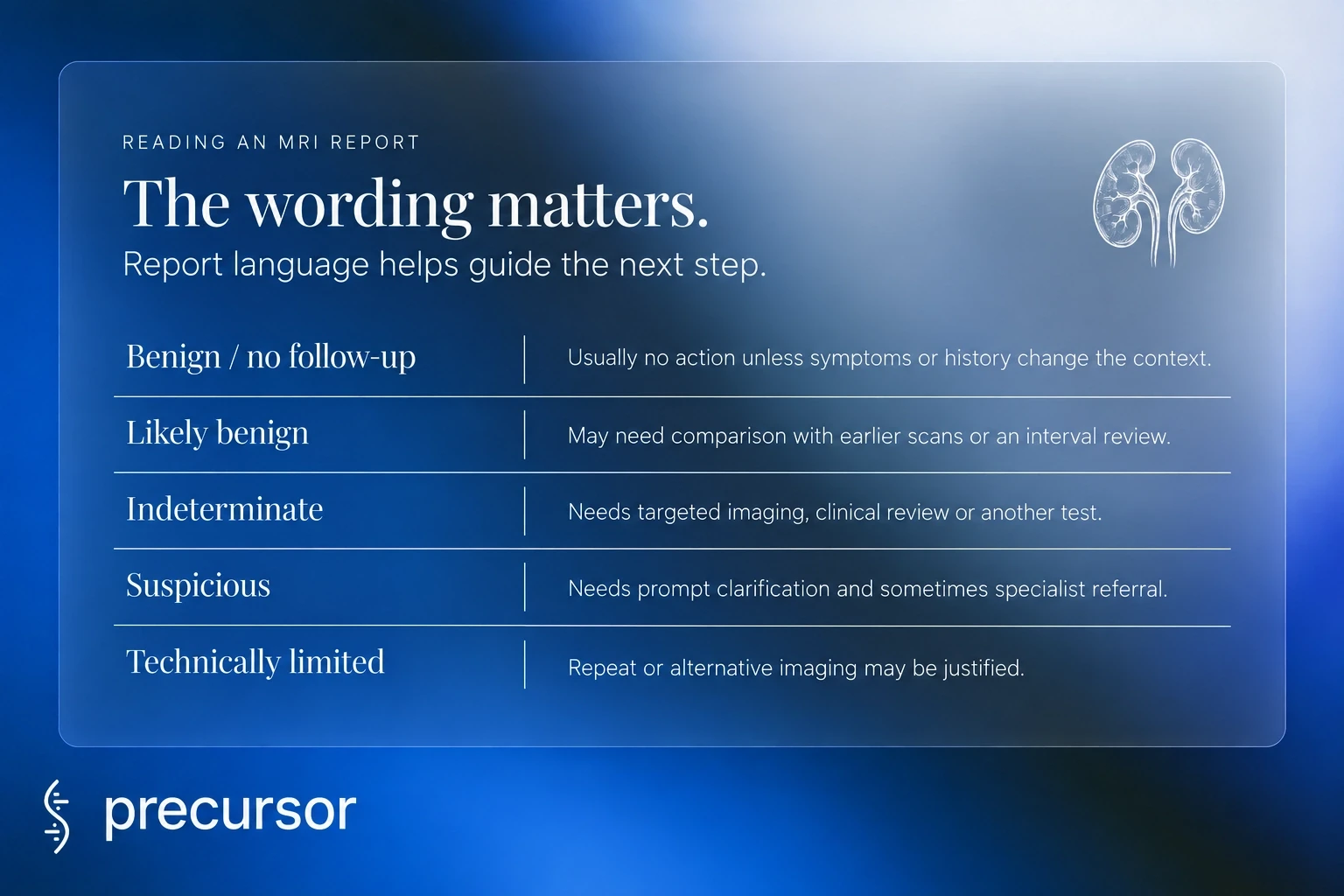
Words you may see in the report
Report wording | What it generally signals | Typical next step |
|---|---|---|
Benign or no follow-up | The appearance is consistent with a harmless finding | Usually no action unless symptoms or history change the context |
Likely benign | The finding looks reassuring but may need context | Comparison with prior imaging or interval review |
Indeterminate | The broad scan cannot classify it confidently | Targeted imaging, clinical review or another test |
Suspicious | Features warrant prompt clarification | Focused assessment and sometimes specialist referral |
Technically limited | Motion or protocol limits confidence | Repeat or alternative imaging if clinically justified |
What happens after the report
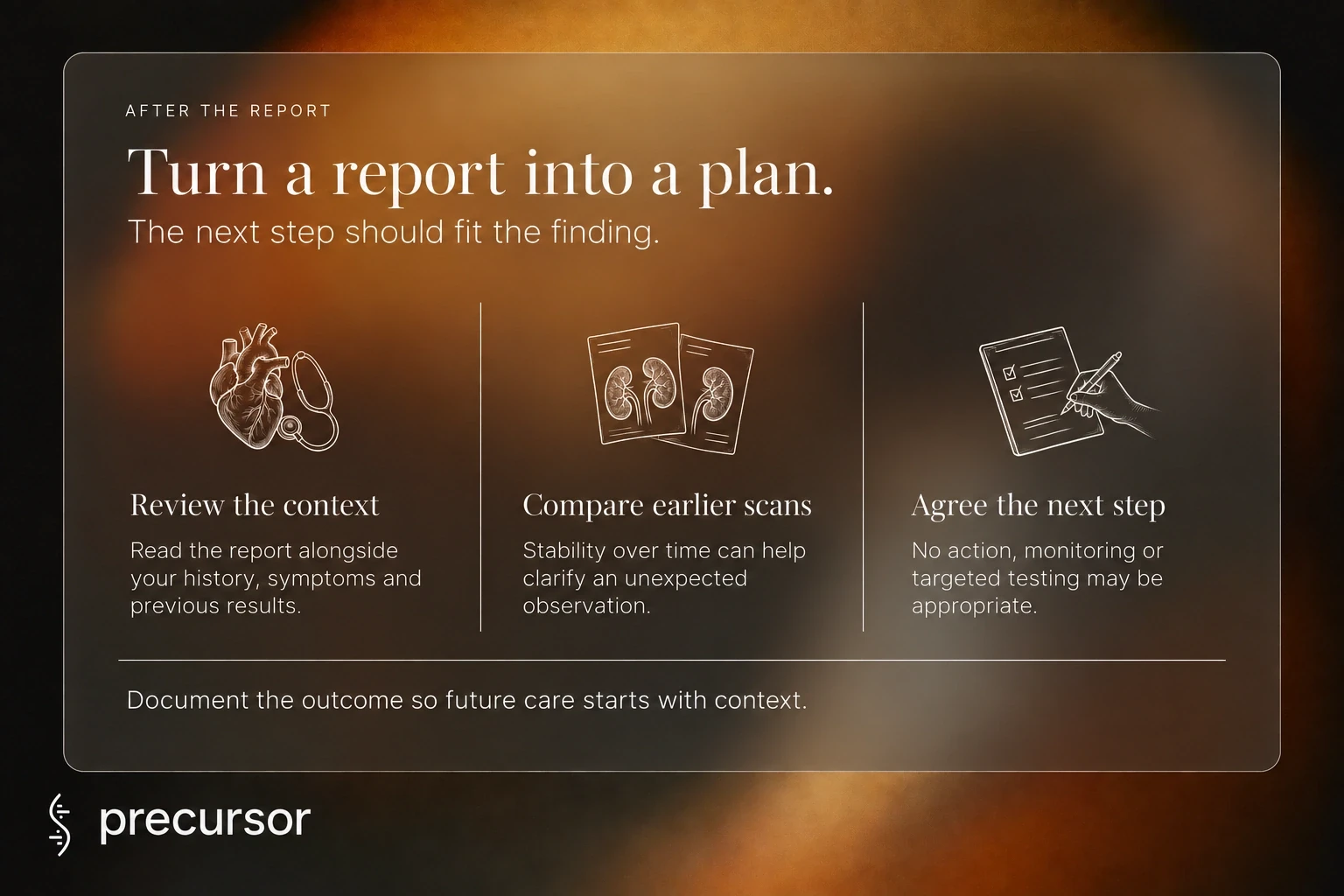
A clinician reviews the wording beside your history, symptoms and previous results.
Old scans are compared when available. Stability over time can be reassuring.
The team decides whether no action, monitoring or a targeted test is proportionate.
If specialist input is needed, the report and images are transferred with relevant context.
The outcome is documented so the finding is not repeatedly rediscovered without a plan.
The costs are not only financial
Follow-up can involve appointments, imaging, travel and out-of-pocket costs. It can also create anxiety while a result remains uncertain. These are recognised harms of screening and should be discussed before the scan, not introduced after an unexpected report. (2, 3)
The answer is not to ignore findings. It is to respond proportionately, use the most suitable next test and stop investigating when the evidence supports stopping.
Questions to ask the service
Who explains incidental findings in plain language?
Will my usual GP receive the report and images?
Who arranges recommended follow-up?
Are follow-up consultations included in the price?
How are urgent findings communicated?
How can I obtain the images for a second opinion?

When symptoms change the situation
A screening result should not override symptoms. If you develop a new or persistent symptom, seek medical assessment even when the report described no concerning finding. The right next test may be targeted and may not be MRI.
Compare the complete MRI pathway before booking
This article provides general information and does not replace individual medical advice.
Frequently asked questions
Does incidental mean cancer?
No. Most incidental findings are not cancer. The term only means the observation was unexpected or unrelated to the reason for imaging.
Why can a broad scan be uncertain?
Whole-body protocols cover many regions in limited time. A finding may need organ-specific sequences, contrast or another imaging method before it can be classified.
Can I decline follow-up?
You can discuss the expected benefit, risk and alternatives with the responsible clinician. The urgency and uncertainty differ between findings, so the decision should be specific rather than automatic.
Should I keep a copy of the images?
Yes. Access to the report and images helps future clinicians compare changes and can prevent the same finding from being investigated again without context.
Sources
Healthdirect Australia
MRI scanRANZCR
Whole Body MRI Screening in Low Risk Patients Position StatementAmerican College of Radiology
ACR Statement on Screening Total Body MRIAustralian Government Department of Health
Screening for cancerKwee and Kwee
Systematic review of whole-body MRI screeningFonseca and colleagues
Meta-analysis of opportunistic cancer detectionMedicare Benefits Schedule
Whole-body MRI item 63564Therapeutic Goods Administration
Gadolinium-based contrast agents safety alert