Full-body MRI: what to know before booking
Full-body MRI offers a broad structural view without ionising radiation. Here is how it can complement a thoughtful, long-term approach to health.

Written by: Gareth Shelwell
Read time: 8 minutes
You may already track bloods, fitness and family history
Those measures each show a different part of your health. Blood tests describe biochemical markers. Fitness assessments show how your body performs. Family and personal history help place risk in context.
Full-body MRI adds detailed structural images across several areas of the body. It is a non-invasive way to look beyond surface measurements and create information that a radiologist can interpret. For someone taking a proactive approach to health, that can be a valuable additional perspective. (1, 6)
The most useful scan is not simply the one with the most images. It is the one that has a clear place in your wider health plan, a careful safety process and a supported route from report to next step.
What to know
Full-body MRI creates detailed images across several body regions without ionising radiation. (1, 6)
The report may identify a structural finding that deserves a more focused review. (2)
A radiologist interprets the images, and clinical context helps turn the report into a proportionate next step. (6)
MRI complements symptom-led care and established screening; it does not replace either. (4)
A different kind of health information
MRI uses a strong magnetic field and radio waves to create images inside the body. It is particularly useful for viewing many soft-tissue structures. A full-body protocol collects images across several regions during one appointment, while a targeted MRI is designed around one organ, symptom or clinical question. (1, 6)
That breadth is one of the reasons people choose a proactive scan. It can bring information from different regions into one radiology report and may reveal a change that was not otherwise apparent. If a finding deserves closer attention, it can guide a more focused conversation or examination.
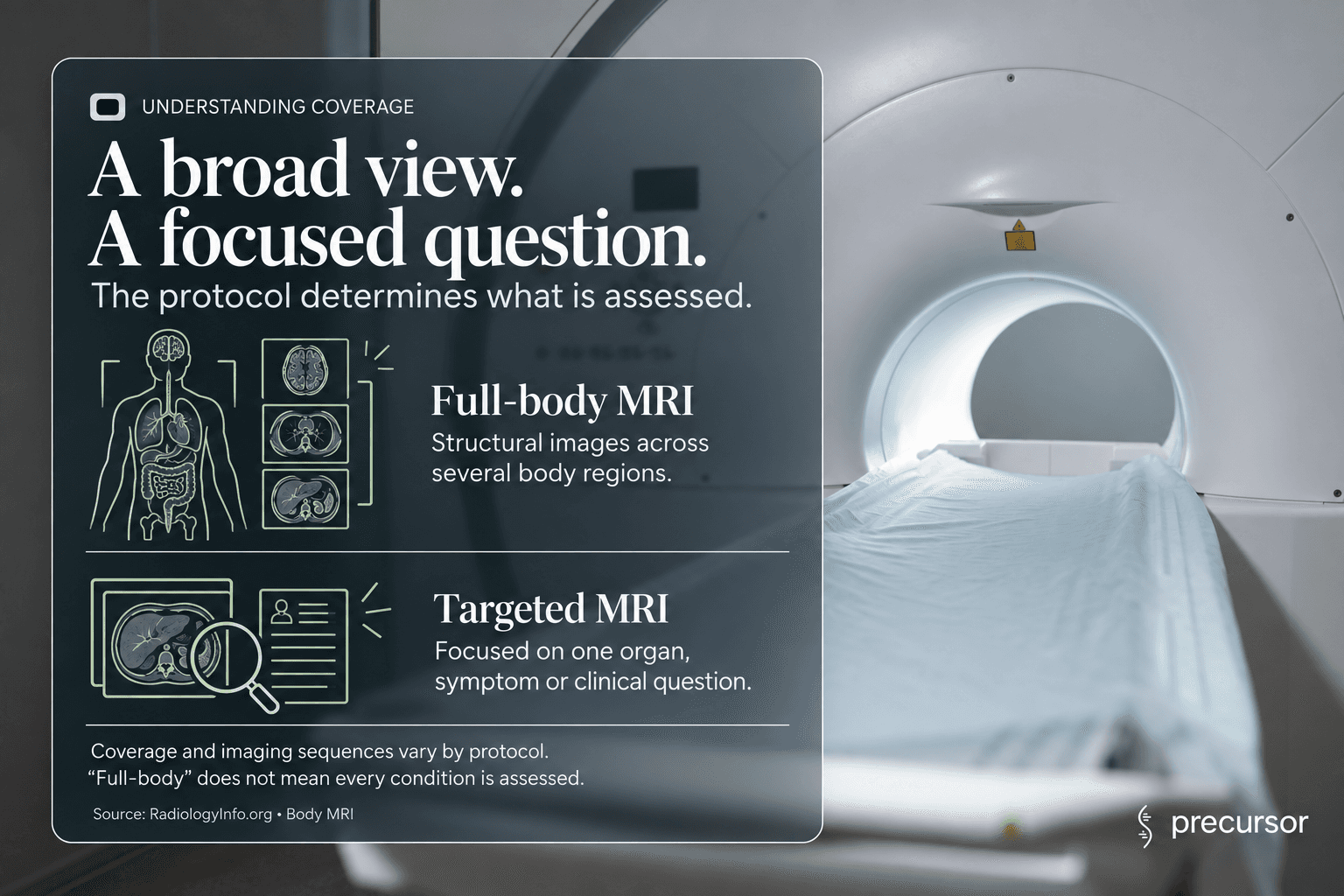
The word “full-body” does not mean that every organ and every possible condition are assessed with the same depth. Imaging sequences and coverage vary by protocol. It is more accurate to think of the scan as a broad structural view, with targeted tests still available when a particular question needs greater detail.
How MRI can support a longevity-focused plan
A longevity-focused plan is built over time. It brings together information about current health, future risk and the habits or care that are worth maintaining. Full-body MRI can contribute a point-in-time view of anatomy to that longer record.
This can be useful in two ways. First, a reported finding may create a clear next step, such as focused imaging or review by the appropriate clinician. Second, a report without a concerning finding can document what was visible within the protocol at that time. Neither outcome predicts the future, but both can make a health discussion more specific.
MRI sits alongside other forms of preventive care rather than competing with them. Recommended cancer screening, blood pressure, blood tests, vaccination, physical activity and symptom-led assessment continue to matter. The scan adds another layer of information to a plan that is already broader than any one test. (4)
From images to a useful report
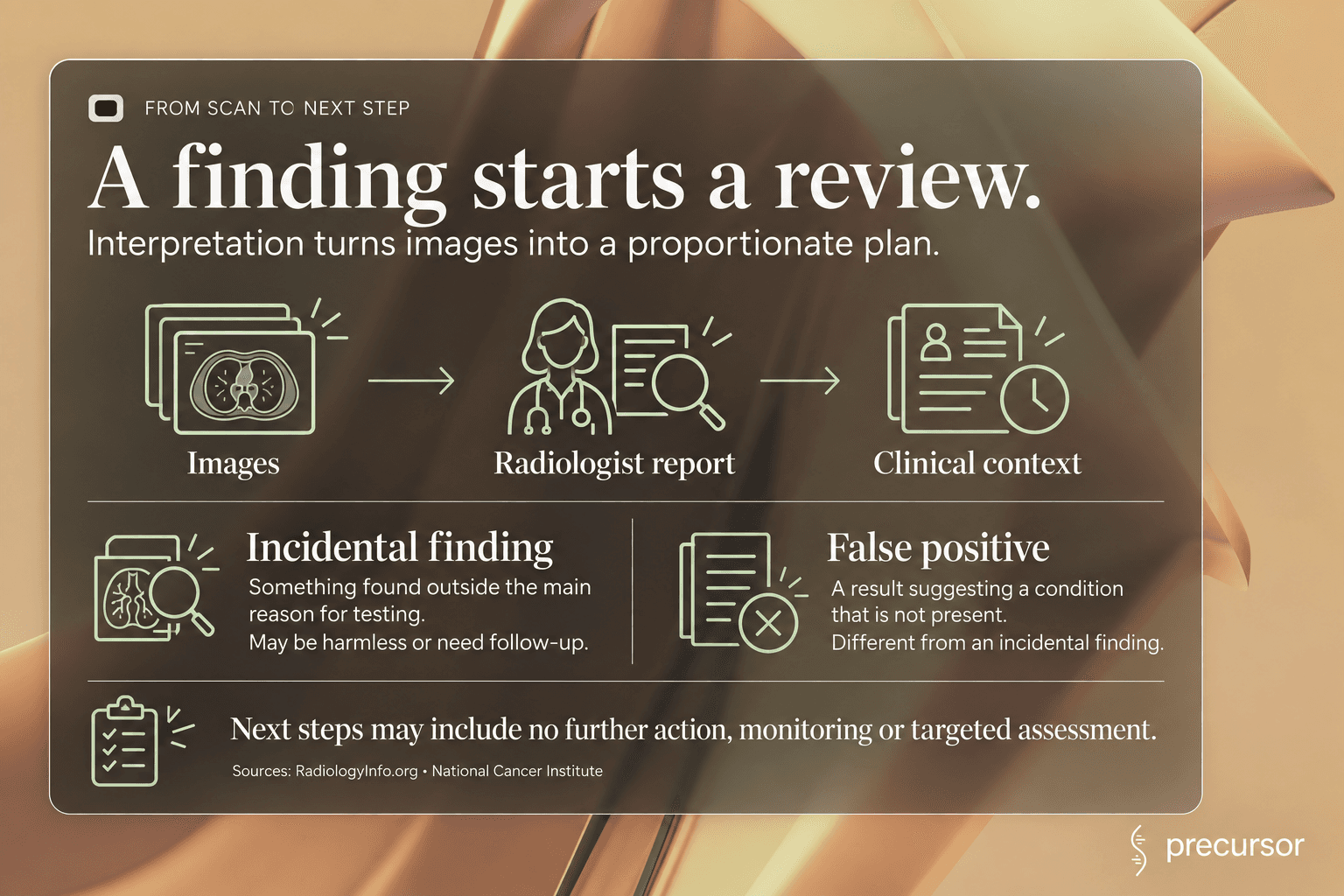
A radiologist reviews the images and prepares a report. The report may describe normal appearances, common variations or a finding that deserves attention. Technical language can make a result feel more dramatic than it is, which is why interpretation matters. (6)
An incidental finding is a change discovered outside the main reason for testing. Some incidental findings are harmless and need no treatment. Others benefit from monitoring or a more targeted examination. A false positive is different: it is a result that suggests a condition that is not actually present. (2, 3)
These possibilities do not make the scan unhelpful. They explain why a full-body MRI works best within a supported pathway. The aim is a proportionate response: recognise what matters, avoid giving harmless changes more weight than they deserve, and connect any meaningful finding with appropriate care.
A calm, non-invasive experience
During the scan, you lie on a padded table that moves into the MRI scanner. The machine makes loud tapping and thumping sounds while it collects images, so hearing protection is provided. The imaging team can communicate with you throughout the examination. MRI itself is painless. (1, 5, 6)
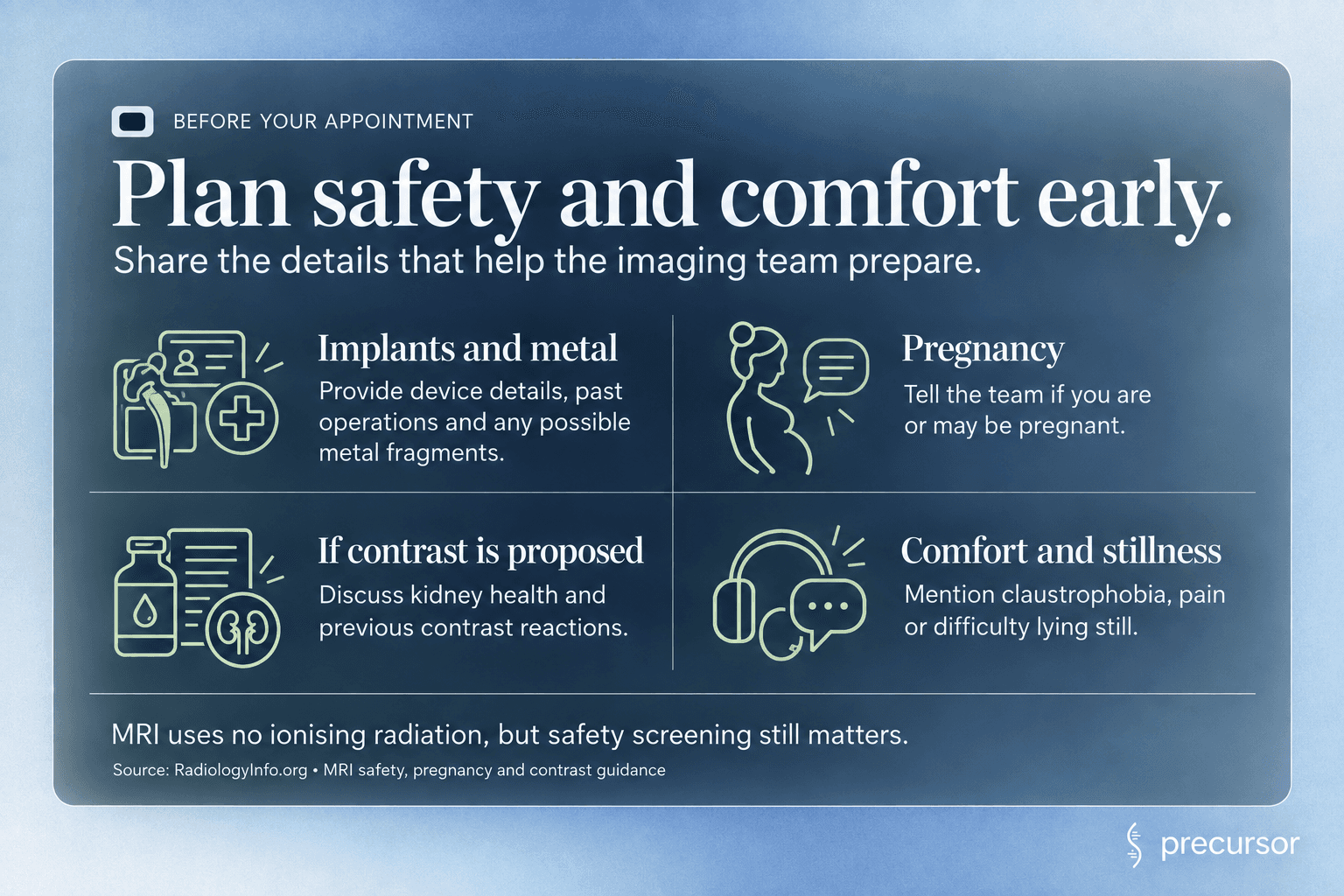
Some people find the enclosed space unfamiliar. Letting the imaging team know about claustrophobia, pain or difficulty lying still allows suitable support to be planned before the appointment. Scan duration varies with the protocol and any preparation.
MRI does not use ionising radiation. If a broader diagnostic package includes CT or another X-ray-based scan as a separate examination, that component does use ionising radiation and should be understood on its own terms. (1)
Safety is planned before the scan
MRI safety screening covers implanted devices, previous operations and possible metal fragments. Many implants can be scanned under defined conditions, while some require additional information or a different approach. Device details allow the imaging team to apply the right safety conditions. (5)
Pregnancy or possible pregnancy should be disclosed before imaging. MRI may be performed during pregnancy when clinically needed, but an elective examination and the use of contrast require their own assessment. Gadolinium contrast is not routinely used during pregnancy. (8)
Some MRI protocols use a gadolinium-based contrast injection to make particular tissues or blood vessels easier to assess. When contrast is proposed, kidney health, previous reactions and the clinical purpose are considered before it is given. (9)
Preparation instructions may cover food, medicines, clothing and arrival time. Following those instructions helps the appointment run smoothly and supports consistent image quality.
Understanding evidence without losing the benefit
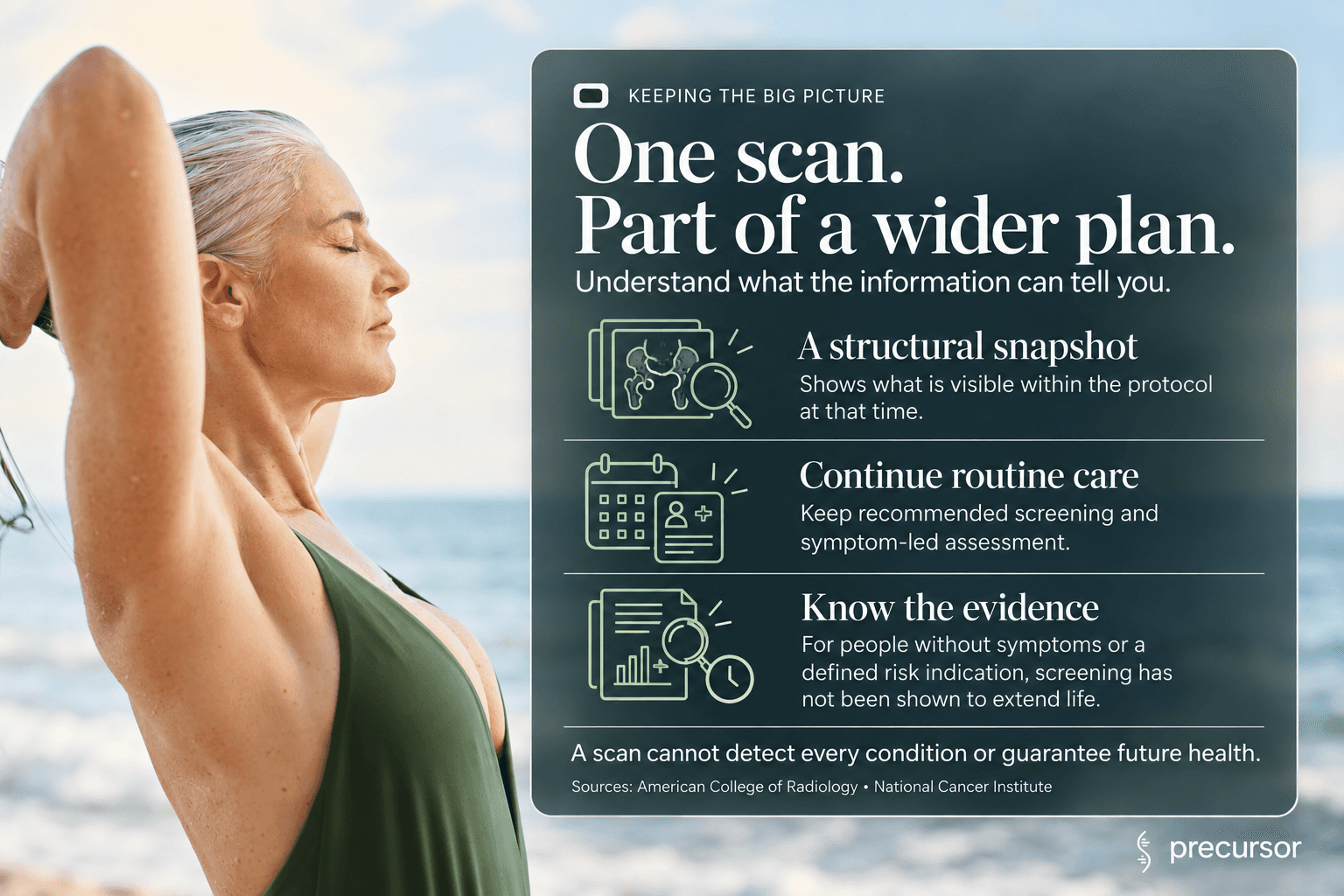
Full-body MRI can show detailed anatomy and may identify findings that lead to useful follow-up. It cannot detect every condition, replace every targeted test or guarantee future health. Cancer screening can also produce false-positive and false-negative results, and in some settings can find disease that would never have caused harm. (3, 4)
For people without symptoms or a defined risk indication, the American College of Radiology notes that evidence has not established that total-body MRI screening extends life. It also recognises the possibility of further tests prompted by findings that are not clinically important. (2)
That limitation belongs in the decision, but it need not become the whole story. People value different kinds of information. A proactive scan may still appeal to someone who understands its scope, wants a broad structural view and has a sensible plan for interpreting the report.
A positive next step with Precursor
Precursor's approach is to place diagnostic information within a wider view of health. Full-body MRI can add structural detail to the blood results, history and health goals you are already considering.
Explore Precursor's full-body MRI service to review the current pathway. You can decide whether its broad, radiation-free imaging view is a useful addition to your longer-term health planning.
This article provides general information and does not replace advice from your treating doctor.
Frequently asked questions
Why consider a full-body MRI as part of proactive health planning?
A full-body MRI provides detailed structural images across several body regions without ionising radiation. It can add an anatomical perspective to blood tests, personal history and physical assessments. Its value is greatest when the report is interpreted in context and any meaningful finding has a clear path to follow-up. (1, 2, 6)
What can a full-body MRI show?
MRI is particularly useful for viewing many soft-tissue structures and may identify an abnormality that deserves closer assessment. A full-body protocol covers several regions, but it is not every dedicated MRI combined into one scan. A targeted examination may still be needed for a particular organ, symptom or finding. (1, 6)
Can a full-body MRI detect cancer?
A full-body MRI may identify some cancers or findings that lead to targeted assessment. It cannot detect every cancer or provide a universal all-clear. Established cancer-screening programs and assessment of new symptoms still have distinct roles, so the scan is best viewed as an additional structural layer. (2, 4)
Does full-body MRI use radiation?
No. MRI uses magnetic fields and radio waves rather than ionising radiation. This is one of its practical benefits for people seeking detailed soft-tissue imaging. MRI still requires safety screening for implants and metal, and a separate CT examination would involve ionising radiation. (1, 5)
Do I need a referral for a full-body MRI in Australia?
MRI in Australia is generally arranged with a doctor's referral. The referral supplies relevant clinical context for the radiologist and connects the resulting report with a clinician. Medicare eligibility depends on the exact examination, referral and applicable rules; elective screening is commonly self-funded. (1, 7)
Is contrast always used for a full-body MRI?
No. Contrast use depends on the protocol and the information the examination is designed to provide. When gadolinium contrast is proposed, the imaging team considers its clinical purpose, kidney health and previous contrast reactions. Pregnancy requires a separate assessment, and gadolinium is not routinely used during pregnancy. (8, 9)
What happens after a full-body MRI?
A radiologist interprets the images and prepares a report. The next step depends on what the report shows and your wider health context. It may be simple documentation, a period of observation or a focused review. Supported interpretation keeps any response proportionate to the finding. (2, 3, 6)
Sources
Healthdirect Australia
MRI scanAmerican College of Radiology
ACR Statement on Screening Total Body MRINational Cancer Institute
Definition of false-positive test resultNational Cancer Institute
Cancer Screening Overview (PDQ), Patient VersionAmerican College of Radiology and Radiological Society of North America, RadiologyInfo.org
MRI SafetyAmerican College of Radiology and Radiological Society of North America, RadiologyInfo.org
Body MRIHealthdirect Australia
Paying for diagnostic testingAmerican College of Radiology and Radiological Society of North America, RadiologyInfo.org
MRI Safety During PregnancyAmerican College of Radiology and Radiological Society of North America, RadiologyInfo.org
Contrast Materials