Position Statement on Coronary Artery Calcium Scoring for Primary Prevention
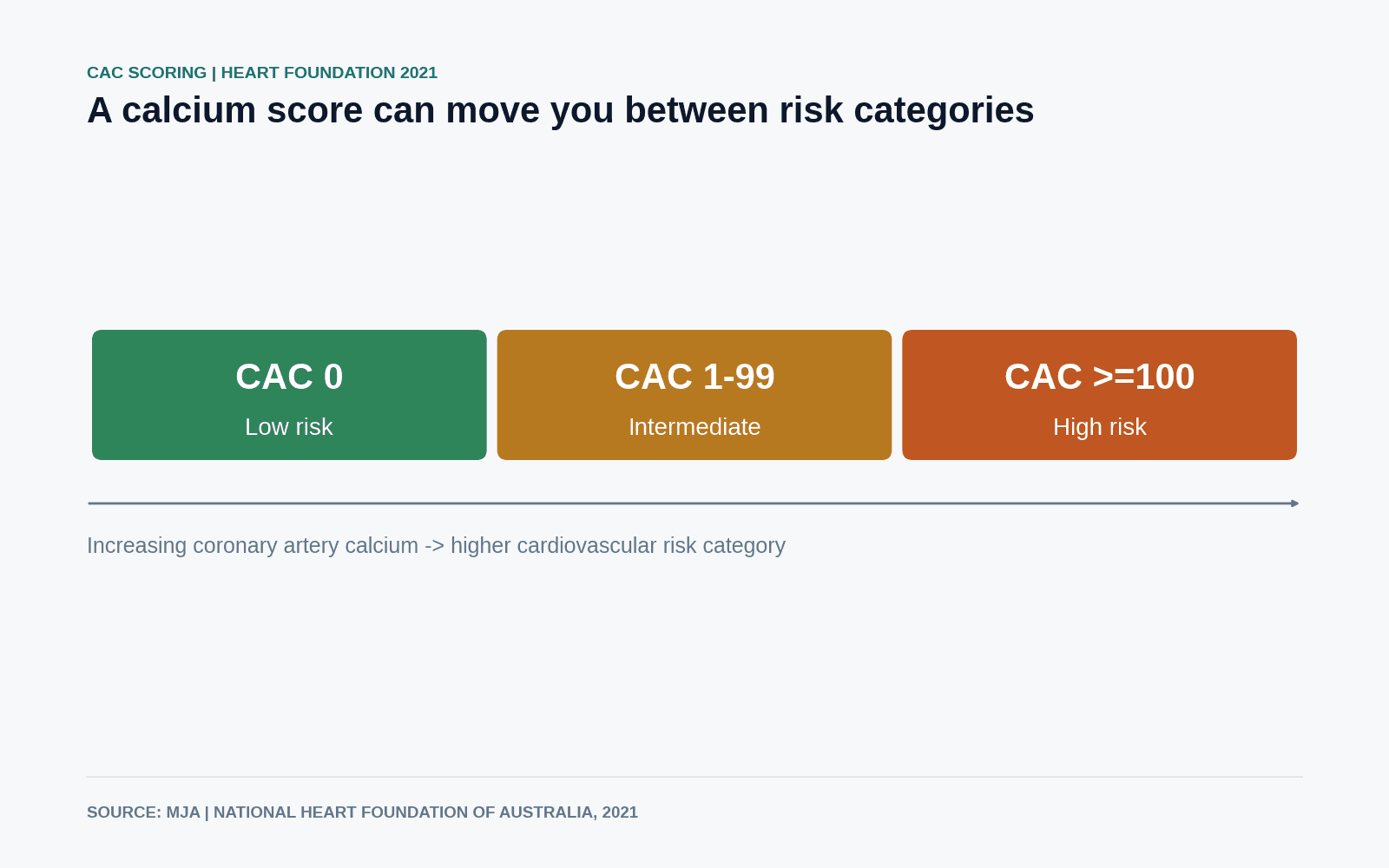
The Heart Foundation says a calcium score of zero can reclassify someone to low cardiovascular risk, while a high score can reclassify them to high risk, directly changing how they're managed.
KEY FINDINGS
Published in the Medical Journal of Australia in 2021, this is the National Heart Foundation of Australia's official position statement on coronary artery calcium (CAC) scoring for primary prevention of cardiovascular disease. It reviews the evidence for CAC scoring and sets out advice for Australian health professionals on when it adds value, building on the National Vascular Disease Prevention Alliance's absolute cardiovascular risk framework already used in Australian general practice.

The Heart Foundation recommends CAC scoring be considered for people at moderate absolute cardiovascular risk, where the result is likely to change how intensively their risk is managed, and for people at low absolute risk who have additional risk-enhancing factors that might mean standard tools are underestimating their true risk.
The score itself can meaningfully shift a person's risk category: a CAC score of 0 can reclassify someone to low absolute cardiovascular risk, while a score above 99, or at or above the 75th percentile for their age and sex, can reclassify them to high risk, in both cases changing the recommended management path.

The significance here is who is behind it. This is the national cardiac authority's own position, not a wellness trend, and it treats a calcium score as something that can move a person between risk categories rather than just add another number to the pile.
That is what makes a test genuinely useful: it earns its place when the result changes what happens next. CAC scoring is recommended precisely where it does that.